Obando Fertility Dance: The Ritual Behind the Three Saints
Every May 17 to 19, dancers fill the streets of Obando, Bulacan, swaying their hips and lifting their hands toward statues of three Catholic saints. The Obando fertility dance is a three-day ritual where childless couples, single adults hoping to marry, and farmers and fishermen praying for a good season take part in a tradition older than Spanish rule in the islands.
Locals call it Sayaw sa Obando, Tagalog for “the Obando dance,” and it forms the core of what most visitors now know as the Obando Festival.
Obando sits on the shore of Manila Bay in Bulacan province, roughly 16 kilometers north of Manila. The town was formally established on May 14, 1753, and named after then governor general Don Jose Francisco Solis de Obando. Before that, it was called Catangalan, after a local tree species. Fishing and farming built the town’s early economy, and both trades still show up in the prayers dancers sing today.
At a Glance
| Detail | Info |
|---|---|
| Location | Obando, Bulacan, on the shore of Manila Bay |
| When | Every year, May 17 to May 19 |
| Celebrates | Three patron saints, one honored each day |
| Origin | Pre-colonial fertility ritual called Kasilonawan |
| Key events | Morning Mass, a procession, street dancing, and a fluvial procession on the third day |
| Who attends | Childless couples, single adults, farmers, fishermen, and families fulfilling a panata |
| Getting there | About 16 km north of Manila, free to attend, no ticket needed |
The Kasilonawan Ritual: Where the Dance Began
Long before Franciscan friars arrived, residents of the area practiced a nine-day fertility ceremony called Kasilonawan. A katalonan, a ritual specialist who mediated between the community and the spirit world, led the rite at the home of the local datu, or village leader. For nine days, the community drank, sang and danced to ask the gods for children, good harvests and full fishing nets.
Accounts of exactly which deity stood at the center of Kasilonawan differ. Some describe a phallic fertility god called linga. Others point to Lakapati, a Tagalog deity tied to agriculture and fertility, or Diyan Masalanta, associated with love and childbirth. The steps, formations and communal singing of Kasilonawan still echo in traditional Filipino dances performed at fiestas across the archipelago today.
Key point
What every account agrees on is the stakes involved: childlessness carried real social stigma in a community that depended on population growth to survive.
Ritual specialists like the katalonan turn up across pre-colonial Tagalog communities, not only in Obando. Spanish chroniclers who wrote about early Luzon described similar figures under the term anito, a broad word for both the spirits addressed and the rites used to reach them.
What made Kasilonawan distinct was its focus: a single request, repeated for nine days, aimed squarely at fertility rather than the wider harvest and healing concerns other rituals covered. That narrow focus is likely why the custom survived colonization when broader animist practice did not.
How the Friars Turned Kasilonawan Into a Catholic Rite
Spanish Franciscans reached the area in the early 1600s and built a chapel in Catangalan, where they enshrined an image of Santa Clara, or Saint Clare of Assisi. She became the settlement’s first patron saint. Rather than stamp out the existing fertility ritual, the friars redirected it.
Historian Kendrick Ivan B. Panganiban describes this as a deliberate missionary strategy: local dancers still danced to prevent or cure sterility, but now the object of the dance was a Christian saint rather than a nature deity.
The parish grew from there. Local church records say the parish traces its founding to April 29, 1754, under the first curate, Fr. Manuel de Olivencia. Scholars studying the shift note something curious: the actual life stories of Santa Clara and the two saints added later have little doctrinal connection to fertility or childbirth. The saints were effectively grafted onto a ritual structure that already existed, and devotees built new meaning around them over the following centuries.
The Three Patron Saints and Their Three Days
Obando has been called the “town of three saints” since the Spanish colonial period, though no single record explains exactly how the three-day, three-saint format came together. What survives is a fixed order that has not changed in generations.
| Date | Saint | Who Traditionally Petitions | What Is Asked |
|---|---|---|---|
| May 17 | San Pascual Baylon | Married couples | A child, and blessings on marriages and households |
| May 18 | Santa Clara | Women who have struggled to conceive, and single women hoping to marry | A child, or a spouse |
| May 19 | Nuestra Señora de Salambao | Fishermen and farmers | A good catch or harvest |
San Pascual Baylon, May 17
San Pascual Baylon was a 16th-century Franciscan lay brother from Spain. His surname resembles the Spanish word for dancing, a coincidence many devotees treat as more than accident.
Santa Clara, May 18
Santa Clara, the town’s original patron, founded the Poor Clares, a cloistered religious order, and lived a celibate life. Devotees sing a verse called “Santa Clarang Pinong-Pino” as they dance:
“Santa Clarang pinong-pino, ako po ay bigyan mo, ng asawang labintatlo, sa gastos di magreklamo.”
Note
That biography makes her an odd fit for a fertility devotion, yet Santa Clara draws the largest crowd of women who have struggled to conceive.
Roughly translated: “Saint Clare, most refined, grant unto me, thirteen spouses, and for the expense I shall not complain.” Unmarried women sing it half in jest, exaggerating their request for suitors, but the underlying wish for a spouse is genuine.
Nuestra Señora de Salambao, May 19
Local legend says three fishermen, sometimes named Juan, Julian and Diego, found the image of Nuestra Señora de Salambao caught in their salambaw, a fishing net. When they tried to bring it to nearby Navotas, their boat grew too heavy to move.
It lightened again only when they turned back toward Obando, a sign the community took as the Virgin’s wish to stay. The image was formally added to the church on June 19, 1763. Her feast falls in the same month as another major Marian tradition, the Santacruzan procession, which many Catholic towns across the Philippines hold in May as well.
A Custom Old Enough to Reach the National Novel
The dance had already become common shorthand for desperate hope by the late 19th century. Jose Rizal, writing “Noli Me Tangere” in 1887, has a character named Doña Pia Alba travel to Obando and dance the pandanggo there so she might finally bear a child. She conceives soon after and later gives birth to Maria Clara, one of the novel’s central figures, though the birth costs Doña Pia her life.
Rizal never explains the custom to his readers, which tells its own story: by the time he wrote the scene, any Filipino reader would have recognized Obando and understood exactly what a trip there meant. The reference has outlived the novel’s other period detail and still gets cited whenever the fertility dance comes up in Philippine cultural writing.
The Dance Steps and the Sung Invocation
The Obando dance belongs to the pandanggo family, the Philippine adaptation of the Spanish fandango. It moves at waltz tempo, with heavy emphasis on swaying hips and hand movement rather than fast footwork. Unlike partner dances such as tinikling, which uses clapping bamboo poles, the Obando dance needs no props at all, just the dancer’s own body and voice.
Researchers who documented the ritual describe five steps, each one a silent prayer. Each step of the Obando fertility dance carries a specific request, not just choreography for its own sake:
- Dancers clasp their hands with thumbs resting toward the chest while waltzing.
- Women push their hands upward over the abdomen while men hold their arms behind their backs.
- Women trace a clockwise circle over the abdomen and point skyward, a gesture men mirror.
- Couples join hands to signal unity.
- Dancers finish by waltzing together with swaying arms, a closing gesture of thanks.
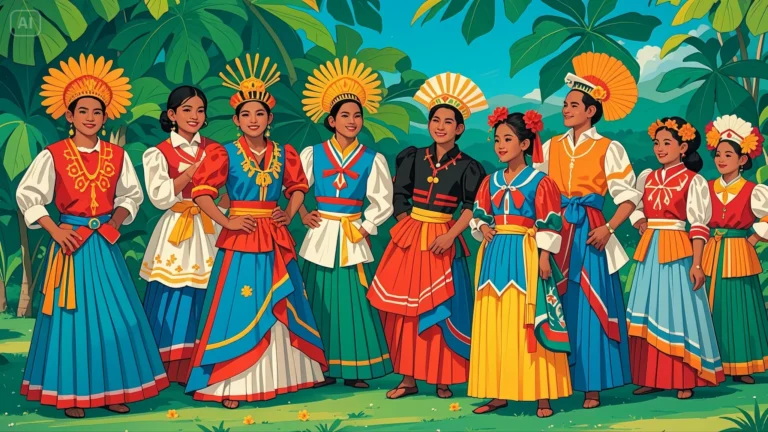
Traditional dancers wear the baro’t saya, a loose blouse-and-skirt set, or its provincial cousin the balintawak. Men wear the barong tagalog, an embroidered long-sleeved shirt, paired with a salakot or a woven buntal hat. Modern performances have folded in steps from the cha-cha, the foxtrot and even the rhumba, so the dance keeps changing shape even as its purpose stays fixed.
Who Dances, and Why
Not everyone who takes part in the Obando fertility dance is trying to conceive. Four main groups make up the crowd, each carrying a different request:
- Childless couples: the most visible group, many treating medical fertility treatment and the dance as complementary rather than competing paths toward a child.
- Single men and women: hoping to meet or marry a partner, a wish captured directly in the “thirteen spouses” verse sung to Santa Clara.
- Farmers and fishermen: praying to Nuestra Señora de Salambao and San Pascual Baylon for a strong harvest or catch rather than a child.
- Families fulfilling a panata: a personal vow made to a saint, often returning years later, sometimes with the child in tow, to dance again as an act of thanksgiving.
Extended family often dances alongside the person making the request, since a birth or a marriage is treated as a shared household concern rather than a private one. It is common to see grandmothers guiding granddaughters through the same steps they danced decades earlier, passing the choreography down without any formal class or teacher involved.
The Obando Festival Today
The modern Obando Festival is organized jointly by the parish and the local government, and it runs the same three-day calendar every year, built around a fixed sequence of events:
- Morning Mass and a novena at the church, officially named the Parish of San Pascual Baylon and Diocesan Shrine of Nuestra Señora de la Inmaculada Concepcion de Salambao.
- A procession around 8 a.m., led by whichever saint’s day it is, accompanied by brass or bamboo bands and lasting two to three hours.
- Street dancing across the poblacion, the town center, for the rest of the day, alongside food fairs and cultural shows.
- On the third day only, a fluvial procession that carries the image of Nuestra Señora de Salambao, a nod to the fishermen’s legend behind her origin.
The dancing itself was not always uninterrupted. Church authorities banned it after World War II, treating the hip-swaying steps as too close to pagan ritual for comfort. Parish priest Fr. Rome R. Fernandez revived it in 1972, and the tradition has run without interruption since.
Recognition has grown since then. The shrine was declared the National Shrine of Nuestra Señora de la Inmaculada Concepcion de Salambao on March 25, 2022, making it:
- The 27th National Shrine in the country
- The fourth National Shrine in the Diocese of Malolos
Obando is not the only Bulacan town with a signature celebration; nearby, the province also hosts the Singkaban Festival, though nothing else in the province blends pre-colonial ritual and Catholic devotion quite as directly as Obando does. Local officials now ask visiting pilgrims to plan trips early, follow traffic advisories during the three days, and keep the streets clean, a sign of how large the crowds have become.
Getting there does not require special planning. Obando sits close enough to Metro Manila that most visitors travel by road in under an hour, and the three-day event is free to attend, with no ticket or registration needed to join the street dancing or watch the processions. Mass and the novena are open to anyone regardless of faith background, though the dancing itself carries far more weight for the Catholic devotees who travel specifically to take part in it.
Tip
Visitors who plan to dance rather than just watch are welcome to join the crowd once the procession reaches the poblacion, no formal invitation required.
The Obando fertility dance survives because each generation keeps finding new reasons to dance it. What began as an offering to nature deities during Kasilonawan is now a Catholic feast attended by families from across the Philippines and overseas Filipinos who fly home for it.
The dance changed partners along the way, from anito to saint, but the request behind it, for a child, a spouse, or a good season, has stayed the same for centuries. Readers curious about how this fits alongside other regional customs can find more in our guide to Philippine traditions.
Frequently Asked Questions
When is the Obando Festival celebrated?
The Obando Festival runs every year from May 17 to May 19 in Obando, Bulacan. Each day honors a different patron saint: San Pascual Baylon on May 17, Santa Clara on May 18, and Nuestra Señora de Salambao on May 19.
Why do people dance during the Obando Fertility Rites?
Dancing is the form the prayer takes. The custom grew out of a pre-colonial ritual in which the community danced and sang to ask nature deities for children and good harvests. Catholic devotees kept the dancing but redirected it to San Pascual Baylon, Santa Clara and Nuestra Señora de Salambao.
Can single people join the dance, or is it only for couples trying to conceive?
Anyone can join. Childless couples dance and pray for a child, but single men and women also take part to ask for a spouse, and farmers and fishermen dance to ask for a good harvest or catch. The dance is open to any devotee with a request or a vow to fulfill.
Is the Obando Festival the same as the Obando Fertility Rites?
Yes. The Obando Festival and the Obando Fertility Rites describe the same three-day event held every May 17 to 19 in Obando, Bulacan. Sayaw sa Obando, Tagalog for the Obando dance, is the local name for the same tradition.
Works Cited
Landy, Thomas M., and Digna Saldana-Sese. “Obando Feast of the Three Saints and Fertility Dance.” Catholics and Cultures, College of the Holy Cross, 4 Aug. 2016, www.catholicsandcultures.org/feasts-holy-days/obando-feast-three-saints-philippines.
“History of Obando Bulacan.” Municipality of Obando, n.d., obando.gov.ph/history-of-obando-bulacan/.
Panganiban, Kendrick Ivan B. “‘Sayaw sa Obando’: The Evolution of Bulacan’s Religious Fertility Rites as Ecclesiastical Cultural Heritage.” Boletin Eclesiastico de Filipinas, Pontifical and Royal University of Santo Tomas, 2023, www.academia.edu/96646270/_SAYAW_SA_OBANDO_The_Evolution_of_Bulacan_s_Religious_Fertility_Rites_as_Ecclesiastical_Cultural_Heritage.
“Obando Fertility Rites.” Wikipedia, Wikimedia Foundation, n.d., en.wikipedia.org/wiki/Obando_Fertility_Rites. </content>