The Evolution of Philippine Media: A Historical Overview
Long before newspapers or radio waves, communities shared news through creative methods. Bamboo tubes carried messages across islands. Town criers called Umalohokan announced updates in village squares. These early practices laid groundwork for a media landscape that would shape a nation’s identity.
Colonial rule transformed how information spread. Spain introduced the first printed newspaper in 1811. American occupation later brought English-language publications like The Manila Times. Each era left marks on press freedom and storytelling styles.
Political shifts often dictated media’s role. During Marcos’ regime, strict controls silenced critics. Yet underground outlets fueled the 1986 People Power Revolution. Radio Veritas became a lifeline, proving journalism’s power in crises.
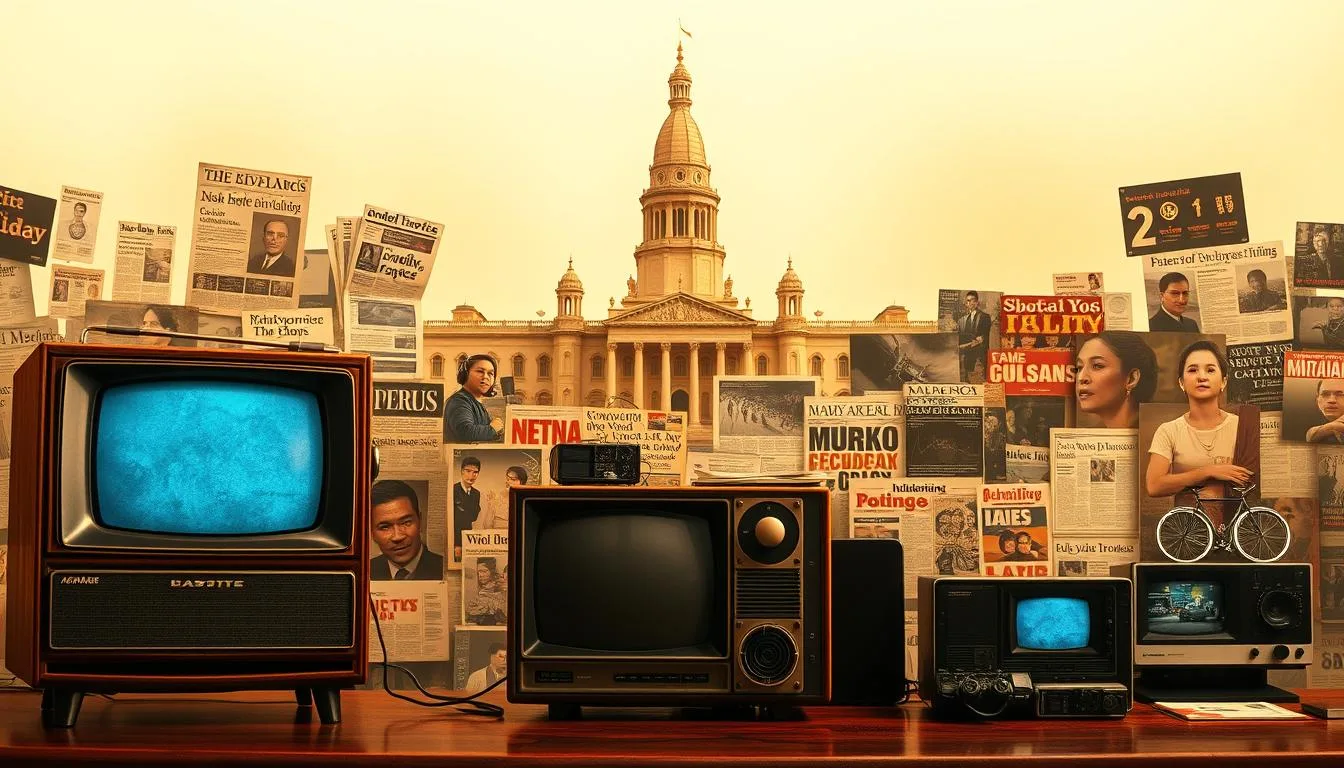
Modern platforms now dominate. Over 80% of Filipinos use social media daily. But traditional TV and radio still hold trust. While digital spaces enable instant sharing, they also spread misinformation, a challenge for today’s consumers.
This journey reveals more than technological upgrades. It shows how news reflects societal values, fights oppression, and adapts to survive. From bamboo scrolls to TikTok trends, every format carries stories of a people’s resilience.
Introduction & Historical Context
Filipino voices echo through diverse platforms today, blending centuries-old storytelling with digital immediacy. Over 450 radio stations and 200 newspapers operate nationwide, yet social media now drives 67% of breaking news consumption. This duality defines a landscape shaped by colonial legacies and modern demands.

Overview of the Philippine Media Landscape
Elite broadsheets like The Philippine Daily Inquirer coexist with mass-market tabloids, reflecting economic divides. Three key forces shape content:
- Family-owned conglomerates controlling major networks
- Community radio preserving regional dialects
- Citizen journalists rewriting news cycles on Facebook Live
Broadcast giants ABS-CBN and GMA dominate TV ratings, while alternative outlets like Rappler challenge traditional power structures.
Media as a Reflection of National Identity
From revolutionary La Solidaridad to TikTok protest songs, narratives mold collective consciousness. The 1986 People Power uprising showcased radio’s unifying power – stations became revolution headquarters.
Modern campaigns like #JunkTerrorBill prove digital spaces amplify dissent. As journalism professor Danilo Arao notes: “Our news doesn’t just report events – it fuels them.” This symbiotic relationship continues defining the nation’s voice.
Early Beginnings and Colonial Influences in Philippine Media
Before ink met paper, stories traveled through chants and carvings. Communities used Baybayin script on bamboo strips alongside oral traditions like Balagtasan debates. Drum patterns relayed warnings across mountains, while smoke signals carried coded messages between islands.
Pre-Spanish Communication Methods and Indigenous Traditions
Village elders preserved history through epic poems like Hudhud. The Umalohokan system allowed leaders to broadcast decrees across regions. These methods ensured vital information reached even remote areas without written records.

Spanish Colonization: The Rise of Print Media and Nationalistic Propaganda
Spain’s 1593 Doctrina Cristiana marked the archipelago’s first printed book. By 1811, Del Superior Govierno became the country’s first regular newspaper. Though initially serving colonial interests, these tools later fueled dissent. Nationalist writers like Marcelo H. Del Pilar secretly critiqued the government through coded editorials.
Foundations of the Modern Press in the Colonial Era
Publications like La Solidaridad (1888) transformed from propaganda sheets into independence platforms. Jose Rizal’s novels circulated as print samizdat, bypassing Spanish censors. This era birthed journalism’s dual role, entertaining elites while quietly mobilizing masses.
When authorities shuttered Diario de Manila in 1898, its presses were smuggled to print revolutionary materials. These colonial-era conflicts forged a press that balanced survival with subversion, a legacy shaping today’s media landscape.
The Evolution of Philippine Media during Key Political Eras
Political tides have repeatedly reshaped how Filipinos access truth and share stories. Three critical periods defined modern media dynamics – American reforms, dictatorship crackdowns, and underground resistance movements.
American Colonization: Shaping New Media Narratives
U.S. forces arrived with typewriters and printing presses. The Manila Times launched in 1898 became Asia’s oldest English-language paper. Military censors delayed war reports but couldn’t stop local adoptions:
- Bilingual editions blending Spanish and English
- Labor movements using mimeograph machines
- Cartoon strips criticizing colonial policies
By 1930, over 60% of newspapers used English. This linguistic shift created lasting divides between elite and grassroots audiences.
Martial Law and the Marcos Years: Government Control and Press Suppression
Ferdinand Marcos declared martial law in 1972. Soldiers padlocked 292 outlets overnight. Only 11 state-approved publications remained. Journalist Joaquin Roces faced arrest for exposing human rights abuses.
Pro-regime outlets like Daily Express dominated airwaves. As editor Letty Magsanoc recalled: “We wrote between redactions – every blank space screamed what we couldn’t say.”
| Era | Media Control | Key Developments |
|---|---|---|
| American (1898-1946) | Military censorship | English-language dominance |
| Marcos Regime (1972-1986) | Outlet closures | Underground newsletters |
| Post-1986 | Constitutional free press | Alternative radio networks |
Emergence of Alternative Media and the Road to Press Freedom
Secret presses hummed in church basements. Alternative media like Pahayagang Malaya circulated through trusted networks. Radio Veritas broadcasted protest plans during the 1986 uprising, reaching 95% of Metro Manila households.
These guerrilla efforts restored freedom while proving Filipinos’ knack for circumventing controls. Today’s digital activists inherit this legacy of resilient storytelling.
Modern Philippine Media Landscape and Digital Transformation
Digital platforms now shape how many Filipinos encounter news. The Philippine Statistics Authority reports that more than 68 million Filipinos aged 10 to 64 used the internet for social media in 2024, but that figure does not mean they used specific platforms daily or for a fixed number of hours.
https://www.youtube.com/watch?v=OGAYBLLRLFc
The Impact of Social Media and Digital News Platforms
Entertainment, eyewitness posts, emergency information, and breaking updates can appear in the same social feeds. During disasters, users should confirm evacuation, weather, and relief information through responsible government agencies and established newsrooms.
Major outlets increasingly design content for mobile and vertical screens. Platform subscriber counts and election behaviour change quickly, so they should be sourced to dated first-party analytics or current research rather than presented as permanent facts.
| Channel | Common strength | Reader check |
|---|---|---|
| Social platforms | Fast distribution and community updates | Verify the original source, date, location, and context |
| Broadcast outlets | Scheduled reporting and live coverage | Compare reports and distinguish news from commentary |
| Print and digital publications | Longer-form reporting and archives | Check corrections, ownership, sourcing, and publication date |
Broadcast and Print Media in the Age of Misinformation
Radio remains king in provinces with spotty network coverage. Stations like DZMM verify trending tweets before airing updates. “We’re not just competing with lies, we’re racing against them,” says GMA anchor Mel Tiangco.
Newspapers fight relevance through niche editions. The Philippine Star’s cryptocurrency section targets young investors. Meanwhile, 5G technology enables real-time fact-checking during live broadcasts, a armor against deepfakes.
As 5G towers multiply, legacy outlets blend old and new. TV Patrol integrates viewer-submitted Reels into primetime. This hybrid approach meets audiences where they are, swiping between memes and headlines.
Conclusion
Philippine media’s journey spans bamboo-carved messages to viral TikTok videos, showcasing adaptive spirit. Colonial rulers introduced print, but locals turned presses into tools for liberation. Decades later, martial law controls birthed underground publication networks, proving information always finds pathways.
Modern platforms amplify voices yet test truth. Over 80% of Filipinos now get news through social media, blending citizen reports with traditional outlets. While digital spaces empower people, they also spread unchecked claims, a challenge requiring media-savvy consumers.
Historical struggles forged today’s diverse media landscape. Radio Veritas fueled revolutions; now hashtags mobilize movements. As 5G networks expand, content creators must balance speed with accuracy. The future demands responsible use of all platforms, ensuring hard-won freedom thrives alongside truth.