The Cariñosa: A Timeless Dance of Love and Filipino Heritage
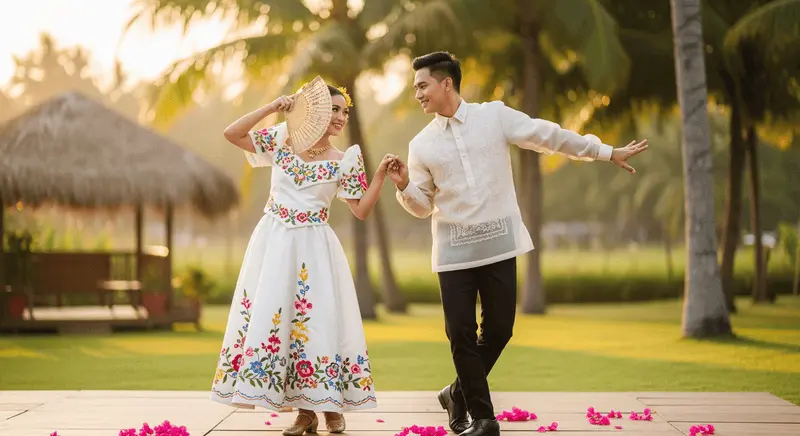
Cariñosa comes from the Spanish word cariñoso, meaning loving or affectionate, and the carinosa dance lives up to its name: a Filipino courtship dance in which a man and woman use a fan and handkerchief to flirt, retreat and eventually connect. It belongs to the Maria Clara suite of Philippine folk dances and traces back to Panay Island in the Visayas, where Spanish colonizers introduced partner dancing in the 16th century.
Three centuries of blending followed. Spanish ballroom structure met Filipino courtship customs that favored indirect, modest expressions of interest over direct contact, and the result is a dance still taught in Philippine schools today. This guide covers what the carinosa dance is, where it began, how it is danced and dressed, its regional forms, and why it is often, if incorrectly, called the Philippines’ national dance.
At a Glance
| Fact | Detail |
|---|---|
| What it is | Filipino courtship folk dance, part of the Maria Clara suite |
| Meaning | “Loving” or “affectionate one,” from Spanish cariñoso |
| Origin | Panay Island, Visayas, during Spanish colonization |
| Dancers | One man, one woman, performed as a couple |
| Props | Fan and handkerchief (two handkerchiefs in the Bicol version) |
| Music | Rondalla ensemble, 3/4 time, roughly 120 to 144 beats per minute |
| Costume | Maria Clara gown for women, Barong Tagalog for men |
| Performed at | Independence Day, National Arts Month, school programs, fiestas |
Key point
Cariñosa is widely taught in Philippine schools as the national dance, but no Republic Act or executive order has ever made that official. A 2014 bill in the House of Representatives to formalize the title did not pass.
What the Carinosa Dance Is
The carinosa dance is a theatrical courtship performance. A man and woman use prescribed gestures, always with a fan or handkerchief in hand, to communicate attraction while keeping a respectful distance. It is the primary courtship dance within the Maria Clara suite, a collection of colonial-era Filipino dances named after the modest, virtuous heroine of José Rizal’s novel Noli Me Tángere.
Where the rest of the Maria Clara suite emphasizes posture and elegance, the carinosa dance tells a specific story. Choreography moves through recognizable stages: acknowledgment, tentative approach, playful teasing, and finally mutual understanding between the two dancers.
Origins on Panay Island
Spanish forces first reached Panay Island in 1569, and the island is now recognized as the birthplace of the most widely performed version of the carinosa dance. Spanish colonizers brought structured partner dances built around close physical proximity and formal gestures. Filipino communities reworked those forms, adding distance and indirection that matched existing local courtship customs, where admiration was shown through gesture rather than touch.
The dance is stylistically linked to the Spanish bolero and the Mexican jarabe tapatío, better known as the Mexican hat dance. It also shares roots with pandanggo, a Filipino dance genre descended directly from the Spanish fandango. From Panay, the carinosa dance spread through the Visayas and then to Luzon and Mindanao, picking up local variations as it traveled.
Note
“Hispanic origin” does not mean the dance is Spanish. Filipino performers reshaped Spanish ballroom conventions around local courtship etiquette, producing something distinct from any dance found in Spain itself.
Music and Rhythm
Carinosa performances traditionally feature a rondalla, the Filipino string ensemble that developed during the Spanish colonial period. Four instruments carry most performances:
- Bandurria: a fourteen-string mandolin that plays the main melody.
- Octavina: an eight-string mandolin filling harmonic support and countermelody.
- Guitar: strummed in patterns drawn from Spanish bolero and habanera styles.
- Bajo de uñas: a Filipino bass guitar anchoring the rhythm section.
The music sits in 3/4 time with a waltz-derived pulse, typically around 120 to 144 beats per minute, though Visayan performances often run slower to emphasize graceful movement while Tagalog versions can move briskly. Musical phrasing follows an AABA structure: the A sections underscore basic courtship gestures, and the B section signals more playful, complex interaction between the dancers.
Costume: Maria Clara Gown and Barong Tagalog
Because of its Spanish-era roots, the carinosa dance is performed in formal Filipiniana dress. Women wear the Maria Clara gown, built from four pieces:
| Garment | Description |
|---|---|
| Camisa | Blouse with butterfly sleeves, often piña or jusi fabric |
| Saya | Long, wrap-around floor-length skirt |
| Pañuelo | Stiff neck covering framing the shoulders and face |
| Tapis | Overskirt layered on top of the saya |
Men wear the Barong Tagalog, an embroidered formal shirt in piña or jusi fabric, worn untucked over dark trousers, a style that sets Filipino formal wear apart from Western shirt conventions. Costume color reinforces the dance’s visual contrast: women typically wear light, pastel tones associated with purity, while men wear darker colors that ground the composition. For a full breakdown of the gown’s construction and regional variants, see our guide to the Cariñosa costume.
The Fan and Handkerchief Ritual
Props carry most of the dance’s meaning. The fan works as both barrier and signal: held open before the face, it suggests shyness; rapid fluttering suggests excitement or playful rejection; a slow, deliberate movement communicates careful consideration.
The handkerchief functions as an offer. A male dancer presents it to his partner, who may accept it immediately, decline, or evade the gesture through teasing footwork. This single exchange creates most of the dance’s dramatic tension.
Tip
Watch for the props first if you are new to the carinosa dance. Fan and handkerchief handling communicates almost the entire courtship story, even before you follow the footwork.
Regional Variations
Because the carinosa dance spread across the archipelago before any formal standardization, distinct regional styles developed side by side.
- Panay and the Visayas: smaller, controlled steps and a moderate tempo, with regional costume and instrumental choices that distinguish it from Luzon.
- Luzon: brisker pacing and more direct handkerchief exchanges, with clearer moments of acceptance or refusal.
- Bicol: according to Francisca Reyes-Aquino’s Philippine Folk Dances, the Bicol version drops the fan entirely and uses two handkerchiefs instead, a more intricate step pattern still performed at regional festivals.
- Visayan variant: some versions extend the courtship narrative so far that the couple mimes combing each other’s hair, a playful, intimate gesture unique to that rendition.
The Courtship Narrative in Movement
The choreography of the carinosa dance moves through four recognizable phases. Dancers begin on opposite sides of the performance space, representing initial separation and mutual awareness.
- Tentative approach: measured steps toward each other, forward-facing, with minimal eye contact.
- Direct interaction: increased eye contact, synchronized movement, and small gestures of growing comfort.
- Playful teasing: the woman retreats as the man advances, a gentle pursuit that mirrors traditional testing behavior in courtship.
- Mutual acceptance: dancers move into closer proximity, sometimes briefly joining hands, signaling agreement.
Throughout, dancers hold upright posture. Emotion comes through small facial changes and gesture quality rather than dramatic physical expression, in keeping with the modesty the Maria Clara suite was built to project.
Is Cariñosa the National Dance? The Myth, Corrected
Philippine textbooks and school programs frequently describe the carinosa dance as the country’s national dance, and the claim traces back to a proclamation credited to President Ferdinand Marcos. That proclamation was never turned into binding law.
In 2014, Representative Rene Relampagos introduced a bill in the House of Representatives to formally designate Cariñosa as the national dance, and it did not pass. To date, the Philippines has no Republic Act, executive order, or other legal instrument naming any dance, including tinikling, as official.
What is accurate is the scale of its adoption. Unlike dances tied to a single ethnic group, the carinosa dance developed variants across nearly every region, which made it a practical, unifying choice for cultural programs even without a law behind the title.
Preserving the Tradition
The National Commission for Culture and the Arts and the Cultural Center of the Philippines have promoted the carinosa dance through official performances and educational programs since the mid-20th century, and Philippine schools have taught it as part of physical education and cultural arts curricula since the 1950s. Companies including the Bayanihan Philippine National Folk Dance Company, the Ramon Obusan Folkloric Group, and Filipinescas Dance Company document regional variants, interview older practitioners, and stage the dance for contemporary audiences.
The dance also travels with the Filipino diaspora. Community centers and cultural associations abroad teach the carinosa dance to Philippine-descended children who did not grow up in the country, using it as a direct line back to Filipino identity. It remains a fixture of Independence Day programs on June 12, National Arts Month in February, and countless fiesta celebrations across the islands.
Frequently Asked Questions
What is the carinosa dance?
The carinosa is a Filipino courtship folk dance from the Maria Clara suite. A man and woman use a fan and handkerchief to act out flirtation, hesitation and eventual acceptance, set to rondalla string music in 3/4 time.
What does Cariñosa mean?
Cariñosa comes from the Spanish word cariñoso, meaning loving or affectionate. The feminine ending marks it as “she who is loving,” describing the flirtatious, tender character of the dance.
Is Cariñosa danced solo or in pairs?
Cariñosa is always performed in pairs, one man and one woman, representing a couple moving through the stages of courtship from shy approach to mutual acceptance.
What music accompanies the Cariñosa?
A rondalla ensemble of bandurria, octavina, guitar and bajo de uñas plays the accompaniment, usually in a moderate 3/4 waltz rhythm derived from the Spanish bolero and habanera.
Is Cariñosa the official national dance of the Philippines?
No. Cariñosa is widely taught as a national dance in Philippine schools, but no Republic Act or executive order has ever made that title official. A 2014 bill to formalize it in Congress did not pass.
Conclusion
Strip away the myth of an official title and the carinosa dance still stands on its own merits: a courtship story told through fan, handkerchief and footwork, performed at fiestas, school programs and diaspora gatherings around the world.
It sits alongside tinikling as one of the two dances most people associate with the Philippines, though the two could not move more differently. Browse the full list of Philippine folk dances to see where Cariñosa fits among the country’s dozens of regional traditions.