Subli Dance: Batangas’ Sacred Dance of Devotion
In Alitagtag and Bauan, Batangas, families have danced the Subli dance as a vow to a wooden cross since at least 1595. It is not staged for ticket buyers or festival judges. It is performed as a panata, a personal promise kept through movement, song and drumbeat, in front of the Mahal na Poong Santa Cruz, the Holy Cross venerated across the province.
Most visitors meet Subli only as a costumed number in a school program. That version strips out what makes it matter. This guide covers where the name comes from, who dances which role, the instruments involved, the multi-hour ritual structure, the May pilgrimage calendar that still shapes it, and why researchers class it as a living devotion rather than a performance piece for an audience.
Subli Dance At a Glance
| Category | Details |
|---|---|
| Region | Batangas, southern Luzon |
| Ethnolinguistic group | Tagalog |
| Props | Kalaste wooden clappers, buri or salakot hats, the Mahal na Poong Santa Cruz |
| Music | Tugtugan drum, kalatong bamboo idiophone, sung dalit verses |
| Dancers | Manunubli, paired men and women, from one couple up to eight couples |
| Occasion | Panata to the Holy Cross, Feast of the Mahal na Poon, early May |
Key point
Subli is a panata, a vow made to the Mahal na Poong Santa Cruz. Devotees dance it as thanksgiving or petition, in front of a cross or inside a home, not as a stage act for an audience.
What Is the Subli Dance?
Subli is a Catholic devotional dance from Batangas province, built around a large wooden cross rather than a choreographed routine for spectators. Dancers, called manunubli, perform it to fulfill a panata, honor a favor already received, or ask for one. In a 1916 ethnographic account, researcher Jose de Villa called it “a form of religious ceremony,” language that still fits more than a century later.
Because it began as a family practice, Subli has no single fixed script. Groups in different barrios keep their own verses, steps and pacing, all built around the same devotion to the cross. What stays constant is the reason for dancing: gratitude, not entertainment.
The practice spread well beyond its birthplace. What started as a barrio-level panata in Alitagtag now reaches other Batangas towns and pockets of neighboring Cavite and Laguna, carried there by families who married, moved, or simply learned the dance from relatives and brought it home.
Why Is It Called Subli?
The most common explanation splits the word into two old Tagalog roots. Subsub means to fall or bow with the head down. Bali means bent or broken. Together they describe how male dancers move: crouched, twisted, and low to the ground through much of the dance.
Not every scholar agrees. Elena Rivera Mirano’s ethnomusicological study of Batangas music and dance, published in 1989 and still the most cited academic work on the subject, argued the word instead comes from an older term, sobli, meaning salisi, an exchange of place. She pointed to how dancers constantly swap positions and directions as the more likely source of the name.
Note
Two theories explain the name. One traces it to subsub and bali, describing the male dancer’s stooped posture. Elena Mirano’s research suggests an older root, sobli, meaning an exchange of place.
Both readings point back to physical movement rather than a story or a place name, which is unusual among Philippine folk dance names.
The Mahal na Poong Santa Cruz of Alitagtag and Bauan
The dance exists to honor one object: the Mahal na Poong Santa Cruz, a large cross carved from anubing wood. According to local accounts, natives found it in the barrio of Alitagtag, then part of Bauan, and the town’s own cross was found in 1595 near a water source. Spanish-era chroniclers already recorded devotion to it within decades of that discovery.
Subli grew directly out of this find. Early tellings describe a cross that could not be moved until people sang and danced before it, which is why the dance and the devotion are treated as one tradition rather than two separate customs. That origin is also why Subli is described as a prayer, not a performance: the dance was the method of the vow before it was ever a spectacle.
Bauan and Alitagtag remain the ritual center of the tradition. Both towns still keep twin crosses, and both still send Subli dancers to meet them during the May feast, a link that has held for generations.
Older Roots Beneath the Catholic Devotion
Some researchers see an older layer beneath the Catholic devotion. The dance’s driving rhythms and repetitive, almost trance-like structure have led a few scholars to argue for pre-Hispanic, animist roots absorbed into cross worship after Spanish contact, rather than a practice invented alongside it. The theory is not settled, but it matches a pattern common across Philippine folk Catholicism, where older customs survived by attaching themselves to a new saint or symbol.
The Male Dancers: Kalaste, Kalatong and the Bent Back
Male manunubli carry kalaste, paired wooden clappers, one in each hand. They strike the clappers together and against their palms to punctuate the drumbeat, while a kalatong, a bamboo instrument struck with two sticks, adds a second rhythmic layer. Their steps include leaps, low crouches and sudden direction changes.
The men’s posture is the clearest physical echo of the dance’s name. Backs bend forward, knees stay low, and movements look deliberately uneven rather than upright and formal. Older accounts describe this as martial in feel, closer to a display of strength than a graceful promenade.
The Female Dancers: Hats and Delicate Hands
Female manunubli dance in contrast to their male partners. They wear a buri or salakot hat, often trimmed with ribbon, and move with small steps on the balls of their feet. Their hands do most of the expressive work, turning, framing the face, and lifting the hat in time with the verses.
Where the men’s movement reads as forceful, the women’s reads as measured and circular. Pairs weave around each other rather than facing off, which is part of why some researchers connect the dance’s name to the idea of exchanging place.
| Role | Performer | Instrument or Prop |
|---|---|---|
| Manunubling lalaki (male dancer) | Men | Kalaste wooden clappers |
| Manunubling babae (female dancer) | Women | Buri or salakot hat, hand fan |
| Tugtugan player | Musician | Tugtugan goblet drum |
| Kalatong player | Musician | Kalatong bamboo idiophone |
| Cantor | Elder or lead singer | Voice, sung dalit verses |
Three Parts of One Long Prayer
A full Subli performance is not one continuous dance. It unfolds in stages, and a complete cycle performed for a serious panata can run several hours, sometimes stretching across more than one day of house-to-house visits during the May novena.
- Kambulong: unaccompanied devotional singing that opens the ritual, sung before any instrument joins in.
- Pinakasubli: the main dance, carried by the tugtugan drum and kalaste clappers, where the bent postures and hat gestures appear.
- Pandangguhan: lighter, faster dance songs that close the sequence and ease the mood after the solemn middle section.
The sung verses, called dalit, use old, image-heavy Tagalog to describe the cross, its discovery, and requests for blessing. Cantors lead call-and-response singing, and the same families often pass specific verses down across generations rather than writing them fresh each year.
The tugtugan itself is traditionally a goblet-shaped drum, its head historically made from monitor lizard skin stretched over a hollowed wooden body. Struck with two bamboo sticks, it produces a low, resonant pulse that carries over a crowd without amplification, which matters for a ritual that often moves from house to house down an open street.
What Manunubli Wear
Costume choices stay close to everyday barrio dress from the period the tradition took shape, not the ornate, sequined versions seen in stage competitions.
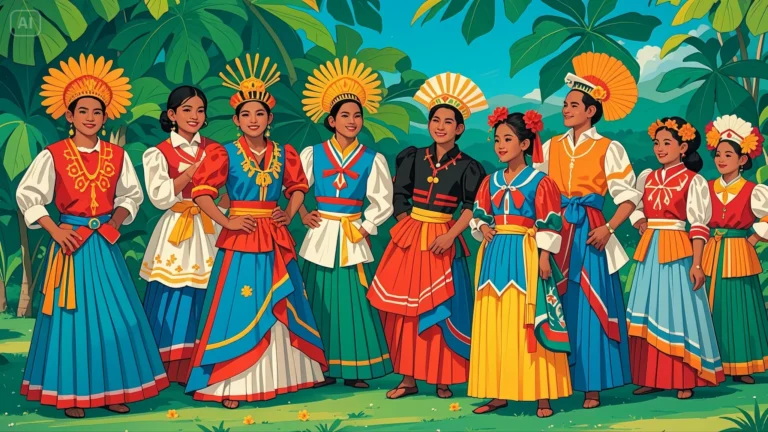
- Women wear a balintawak-style dress with butterfly sleeves, a checkered or floral skirt, and a pañuelo draped over the shoulders.
- Men wear a translucent barong tagalog over dark trousers, sleeves loose enough for the clapper work.
- Both sexes typically dance barefoot, a detail many staged versions drop for practical reasons.
- The cross itself is usually draped in white cloth for the procession portion of the ritual.
None of these pieces use sequins, machine embroidery or metallic trim, a deliberate contrast with the costumes seen at staged folk dance competitions.
The Maytime Pilgrimage Calendar
Subli is tied to a specific run of dates each May, when Batangas towns hold processions, novenas and Subli performances in sequence rather than on one isolated festival day.
| Date | Town | Event |
|---|---|---|
| May 1 | Alitagtag and Bauan | Novena for the Mahal na Poon begins |
| May 2 | Alitagtag and Bauan | Salubong, the meeting of the twin crosses |
| May 3 | Bauan | Feast of the Mahal na Poon, main Subli procession |
| May 3 | Batangas City | Sublian Philippine Festival |
| Last Sunday of May | Alitagtag | Grand La Paz observance |
| May 31 | Alitagtag | Tapusan, closing of the May novena |
This calendar runs alongside other Marian devotions filling the same month, including the Flores de Mayo season and the Santacruzan procession held in many other provinces. Subli is Batangas’ own version of that Maytime pattern, built around a cross instead of a queen and court.
On the main feast day, the twin crosses of Bauan and Alitagtag travel together by float to a barangay chapel for Mass, the recitation of luwa poetry, and Subli dancing. In the afternoon, the procession crosses Manghinao Bridge back toward Bauan, where devotees line the street to throw flowers before the crosses reach the parish church patio and a final round of dancers.
A Living Ritual, Not a Stage Show
Most Philippine folk dances survive today mainly through school programs and cultural troupes. Subli is one of the few still danced primarily as religious practice, inside homes and chapels, by people fulfilling a personal vow rather than performing for an audience.
A few signs separate the ritual version from a staged number of traditional Filipino dances:
- No entrance fee or printed program, because there is no paying audience.
- Dancers step inside a home or small chapel, not onto a stage.
- The sequence pauses around prayers and greetings, not applause cues.
- The same families perform it across generations as a household panata.
Tip
To see Subli as a living devotion rather than a staged routine, visit Alitagtag or Bauan between May 1 and May 3, when house-to-house novena dancing still happens ahead of the main procession.
Staged Subli still exists, and it has value for teaching the steps to a wider audience. But researchers studying Batangas devotional music, much like those who study the province’s kulintang-adjacent traditions elsewhere in the archipelago, treat the ritual version as the primary form and the stage version as a derivative of it.
Will Subli Survive as a Living Ritual?
Urbanization has thinned the number of families who still keep the full panata cycle. Researchers who track the tradition point to a few recurring pressures:
- Younger dancers learn only the shortened stage version through school folk dance units.
- Multi-day house visits during the May novena happen less often each year.
- Fewer families still pass down the full run of dalit verses by ear.
That shift worries the people who have spent decades documenting Subli, because a stage routine can teach the steps but cannot replace the sense of obligation that comes with a personal panata to a specific cross.
None of that has erased the tradition. Every May, Alitagtag and Bauan still bring out their crosses, and manunubli still dance in front of them, exchanging places just as the name suggests. That continuity, more than any single performance, is what keeps Subli counted as a living ritual rather than a museum piece.
Subli sits alongside dozens of other devotional customs that still shape what a fiesta means to a Filipino town, and our Traditions section covers more of them, from harvest rites to household vows still kept today.
Frequently Asked Questions
What does the Subli dance mean?
Subli most likely combines subsub, meaning stooped or bowed, and bali, meaning bent or broken, describing the male dancer’s crouched posture. A separate scholarly reading by Elena Mirano traces it to the older word sobli, meaning an exchange of place.
Where did Subli originate?
Subli began in the barrio of Alitagtag, then part of Bauan, Batangas, tied to the discovery of a wooden cross that became the Mahal na Poong Santa Cruz. From there it spread across Batangas and into parts of Cavite and Laguna.
What props do Subli dancers use?
Male dancers carry kalaste, paired wooden clappers, and sometimes small bells. Female dancers wear a buri or salakot hat decorated with ribbons or paper flowers, which they lift and turn during the dance.
Is Subli still performed today?
Yes. Families in Alitagtag and Bauan still dance it house to house as a panata during the May novena, alongside staged versions performed at the Sublian Festival and in schools.
How is Subli different from other Batangas ritual dances like Kuraldal?
Both are devotional, but Subli centers on the Mahal na Poong Santa Cruz and follows a fixed sequence of sung sections, while Kuraldal, from Pampanga, honors Apung Iru and is danced in a tighter, more repetitive procession step.
Works Cited
“Bauan Church.” Wikipedia, Wikimedia Foundation, https://en.wikipedia.org/wiki/Bauan_Church.
“The Folkloric Origin of the Subli Dance of Batangas from a 1916 Ethnographic Paper.” Batangas History, Culture and Folklore, 2019, https://www.batangashistory.date/2019/05/folkloric-origin-subli-dance-batangas-from-1916-ethnographic-paper.html.
Mirano, Elena Rivera. Subli: Isang Sayaw sa Apat na Tinig / One Dance in Four Voices. National Commission for Culture and the Arts, 1989.
National Commission for Culture and the Arts. “Philippine Dance Research and Documentation.” NCCA, ncca.gov.ph, https://ncca.gov.ph/about-ncca-3/subcommissions/subcommission-on-the-arts-sca/dance/philippine-dance-research-and-documentation/.
“Subli.” Wikipedia, Wikimedia Foundation, https://en.wikipedia.org/wiki/Subli.
“Sublian Festival.” Wikipedia, Wikimedia Foundation, https://en.wikipedia.org/wiki/Sublian_Festival.