Kuratsa Dance: History, Meaning and How It Is Performed
Guests at a Waray wedding do not just watch the kuratsa dance. They step in one by one and pin peso bills onto the bride and groom while the couple sways through a courtship routine that mimics a rooster chasing a hen. The custom is old, and it still helps pay for fiesta expenses across Samar and Leyte.
The dance splits into three parts: a slow courtship, a playful chase, and a final surrender when the two dancers finally move together. Writers disagree on where the name Kuratsa came from, and that disagreement is part of the story. This guide covers the steps, the disputed origin, and the wedding custom most Filipinos know it for today.
At a Glance
| Detail | Description |
|---|---|
| Region | Eastern Visayas, strongest in Samar and Leyte |
| Ethnolinguistic group | Waray people, also danced in Bicol and parts of the Visayas |
| Props | None required, though a handkerchief appears in Bicol versions |
| Music | Rondalla or string band, 3/4 time, a waltz that speeds up |
| Dancers | One couple at a time, a rule called amenudo |
| Occasion | Weddings, fiestas, family reunions |
| Costume | Patadyong and camisa for women, barong or trousers for men |
What Is the Kuratsa Dance?
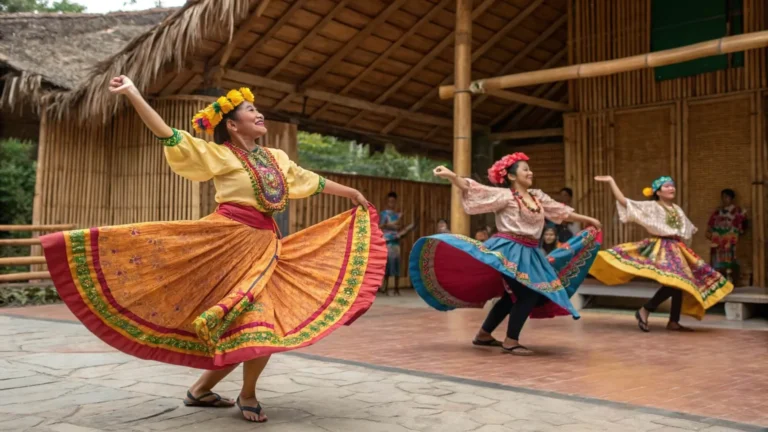
Kuratsa is a Filipino courtship dance from the Visayas region. It imitates the courtship of a rooster and a hen, animals that carried real value for Waray farming families. The male dancer struts and pursues, and the female sways and slips away, teasing him without refusing him outright.
Dancers do not follow fixed choreography the way ballet does. Instead they improvise within a shared vocabulary of moves, including the sarakiki hip sway and duon, a light stamping step. Because the dance rewards personality, no two performances look quite the same, even within one barangay.
Audiences take the amenudo rule seriously. Stepping onto the floor while another couple is still dancing is treated as a real breach of manners, not a minor slip. Onlookers form a loose circle instead, clapping the beat and waiting their turn.
- Only one couple dances at a time, a rule called amenudo.
- The music always builds from slow to fast within a single performance.
- The watching crowd, not a stage, forms the natural boundary of the dance floor.
Three Parts: Courtship, Chase and Surrender
Every kuratsa performance follows the same three-part arc, even though the steps themselves vary by town. Dancers and choreographers describe the parts as courtship, chase, and surrender, echoing how the dance imitates animal pairing.
- Courtship. The music opens as a slow waltz. The couple approaches, bows, and circles with small, polite steps, much like a rooster and hen sizing each other up.
- The chase. The tempo doubles. The male dancer pursues his partner with quick footwork called sagparak, named for the frantic motion of a cockfight, while she retreats and circles.
- The surrender. The music slows again. The two dancers finally move in sync, closing the distance that opened the performance, and the crowd claps or starts pinning money as the couple takes a final bow.
Key point
The kuratsa always moves in the same order: courtship, chase, then surrender. Skip a phase and the performance breaks a pattern dancers in Samar and Leyte have followed for generations.
A Disputed Origin: Cuaracha or Indigenous Waray Form?
Where the name came from is genuinely unsettled, and cultural writers split into two camps. The first traces it to La Cucaracha, a courtship dance from the Monterrey region of Mexico, said to have crossed the Pacific during the Manila-Acapulco galleon trade. Spanish and Mexican sailors passed through Eastern Visayan ports for centuries, and Kuratsa sounds close enough to Cucaracha to suggest borrowing.
- Mexican import theory: The name resembles La Cucaracha, and the galleon trade routinely moved goods, people, and customs between Acapulco and Manila for over two centuries.
- Indigenous Waray theory: The steps, structure, and courtship narrative trace to the older Samar kigal and bikal dances, and the music is bolero-inspired rather than Mexican.
A second group of Philippine dance researchers argues the dance is homegrown. They trace it to the kigal, an older Samar dance also called binanug, after banug, the Waray word for hawk. It appears in a seventeenth-century Samarnon dictionary attributed to the Jesuit missionary Alcazar.
These researchers point to specific evidence. The kigal step called sabay closely matches the kuratsa step called dagit, and a block-and-chase sequence called palanat appears in several Samar couple dances but never in the Mexican Cucaracha. The two dances, they argue, share a borrowed name and little else.
Note
Neither camp has settled the debate. What both sides agree on is that Spanish colonial contact shaped the dance’s music and courtesies, even if the core steps are older and native to Samar.
Kigal and Bikal: The Older Dances Behind the Debate
The kigal and bikal do more than support the indigenous origin argument. Both survive today in fragments, and tracing them shows how much older Visayan dance culture runs beneath the kuratsa.
The bikal is considered a forerunner of the Waray balitaw, a musical joust of improvised verses between a man and a woman. Its performance style survives today as the ismaylingay, kept alive mostly by aging song leaders called magsiriday in parts of Samar.
The block-and-chase choreography, called palanat, also turns up outside the kuratsa itself. Samar dances such as the ismaylingay, amoracion, alimukon, and kuradang all use a version of the same pursuit pattern. Researchers treat that overlap as evidence of one shared, older dance family rather than several unrelated imports.
Why the Waray Heartland of Samar and Leyte Keeps It Alive
The kuratsa dance stays strongest in Samar and Leyte because it never left daily life there. Families still open wedding receptions with it, and fiesta committees schedule a kuratsa slot the way other towns schedule a raffle.
The dance also survives through direct teaching. In 2018, University of the Philippines Tacloban professor Joyce Dorado Alegre, speaking for the Leyte-Samar Heritage Society, told the Philippine News Agency that most young Waray people already know the steps but need lessons in the dance’s meaning, not just its movement.
Leyte also hosts the Pintados Festival, tattooed street dancing that showcases the same regional pride the kuratsa carries into weddings and reunions.
- Weddings and fiestas across Samar and Leyte still schedule the dance as a fixed part of the program.
- Local heritage groups actively teach the steps to children, not only to adults.
- Town variants, like the Kuratsa Binuaya of San Miguel, Leyte, keep local legends attached to the dance.
The Wedding Money Dance: Pinning Bills on the Couple
Most Filipinos today know the kuratsa mainly as the wedding money dance. During the reception, sponsors, relatives, and guests take turns pinning cash onto the newlyweds’ clothes or tossing bills around them, a custom called the gala.
The amounts are usually modest. Denominations of 20, 50, and 100 pesos are common, and the totals can still add up once dozens of guests take a turn. The tradition fits into wider Filipino wedding traditions, where guests are expected to help fund a couple’s new household directly.
Tip
Invited to a wedding where the kuratsa will be danced? Small bills work best. Guests usually pin several 20 or 50 peso notes rather than one large bill, so the couple collects from as many well-wishers as possible.
Cultural historian Nilo Oquendo, quoted by The PH Insider in 2025, described the gala as a courtship of the community itself. A 68-year-old fiesta attendee in Catbalogan told the same outlet the custom reads as communal help, not display, since neighbors who cannot attend the wedding will often still send an envelope through a relative who is going.
The offerings were not always cash. Older accounts describe guests giving rice, cloth, or coins before peso bills became the default gift sometime in the mid-20th century. Sponsors, or ninong and ninang, typically dance first and set the pace for how generous the rest of the room will be.
Music and the Rondalla
A rondalla, a string ensemble built around bandurria, laud, guitar, and bass, provides the traditional soundtrack for the kuratsa. Some barangays substitute a small brass band, but the melody keeps the same shape either way.
The music runs in 3/4 time and starts as a gentle waltz. It speeds into a livelier bolero rhythm for the chase, then eases back down as the dancers reach the surrender. Musicians read the dancers’ cues rather than a fixed score, so no two live performances sound identical.
Recorded versions have circulated since at least the late 1950s, when Juan Silos Jr. and his rondalla released a kuratsa track on an early Philippine folk dance album. Regional variants such as the Kuratsa Boholana were pressed onto 78 rpm records decades ago, which is partly how the tune spread beyond Samar and Leyte.
Costume: What Dancers Wear
Female dancers usually wear a patadyong, a woven, tube-shaped skirt from the Visayas, paired with a camisa, a lightweight blouse with butterfly sleeves. Some dancers add a soft pañuelo scarf draped over one shoulder.
Male dancers wear simple trousers with a loose shirt, or a barong tagalog for formal weddings and competitions. Neither costume calls for props, since the kuratsa’s real display sits in the footwork and posture, not accessories.
Colors tend toward the bright, everyday palette of provincial Visayan wear rather than the muted formal tones used in the barong tagalog for church weddings. Bold checks and stripes are common on the patadyong, since the fabric was originally woven for daily use, not for performance alone.
Learning and Performing the Kuratsa Today
School cultural clubs and barangay dance troupes remain the main way younger Filipinos learn the kuratsa now. Coaches usually teach the three-part structure first, then let dancers add their own flourishes once the basic timing is solid.
Folk dance competitions, both regional and national, keep a slot for Visayan couple dances, and the kuratsa is a frequent entry alongside the tinikling and the pandanggo. Judges tend to reward dancers who improvise convincingly rather than those who repeat memorized steps.
Outside formal competition, most Waray people still learn it the older way: by watching relatives dance at weddings and joining in once they are confident enough. A few practical pointers help beginners:
- Watch a full performance before attempting any steps, since the chase and surrender only make sense once you have seen the courtship phase that sets them up.
- Practice the tempo change first. Many beginners get the footwork right but rush or drag the shift from waltz to chase.
- Expect to improvise. A kuratsa performed exactly the same way twice is treated as a beginner’s mistake, not a skill.
Regional Variants: Kuratsa Menor, Bicol and Beyond
The dance is not one fixed routine. Samar alone recognizes several named versions, and neighboring regions have adapted it to local taste.
| Variant | Region | What Differs |
|---|---|---|
| Waray Kuratsa (Kuratsa Menor) | Samar and Leyte | The standard version: slow waltz opening, fast chase, gentle close |
| Kuratsa Mayor | Samar and Leyte | A bolder, more daring version usually reserved for weddings and skilled dancers |
| Kuratsa nga Pinayungan | Samar | Danced with umbrellas, traditionally performed during rainy-season fiestas |
| Bicol Kuratsa | Bicol region | Dancers hold opposite ends of a handkerchief throughout the routine |
| Kuratsa Boholana | Bohol, Visayas | A Boholano adaptation, closer in tempo to western Visayan style |
Kuratsa Menor remains the version most schools and cultural troupes teach first, since its structure is easier to learn before dancers attempt the more theatrical Mayor or Pinayungan forms. Readers exploring more regional Philippine traditions will find the same pattern: a core form, then a scatter of local variants shaped by geography and available props.
A Dance Still Danced Today
The kuratsa dance has outlasted plantation economies, colonial rule, and decades of migration out of Eastern Visayas. It survives because it still does real work: it opens receptions, raises money for newlyweds, and gives every generation in Samar and Leyte a shared step to fall back on.
Kuratsa is one of dozens of regional forms still performed across the islands, and our guide to traditional Filipino dances maps how each one differs from town to town.
Frequently Asked Questions
Is the kuratsa the same dance as the cariñosa?
No. Both are Filipino courtship dances, but the cariñosa is a national dance with fixed fan-and-handkerchief choreography. The kuratsa is a regional Waray dance built around improvised steps and a rooster-and-hen chase.
Can anyone join a kuratsa performance?
Only one couple dances at a time, a rule called amenudo. Guests join a different way, by taking turns pinning money on the dancers or tossing bills during the wedding money dance portion.
What does gala mean in the kuratsa tradition?
Gala refers to guests giving cash, and historically rice, cloth, or coins, to dancers or newlyweds during the performance. It functions as community support rather than a display of wealth.
Do dancers rehearse before performing the kuratsa?
Rarely in a formal sense. Dancers work from a shared vocabulary of steps and largely improvise the performance, which is why no two performances look exactly alike.
Is the kuratsa an officially recognized national dance?
No. Unlike the tinikling or cariñosa, the kuratsa has no formal national designation. It remains strongest as a living regional tradition in Samar and Leyte rather than a textbook showcase dance.
Works Cited
Amigo, El. “Money in the Air: The Kuratsa Tradition and the Debate Over Generosity in Hard Times.” The PH Insider, 26 Aug. 2025, https://thephinsider.net/money-in-the-air-the-kuratsa-tradition-and-the-debate-over-generosity-in-hard-times/.
“The Grace of the Waray Kuratsa Traditional Philippine Dance.” Academia.edu, n.d., https://www.academia.edu/8631446/The_Grace_of_the_Waray_Kuratsa_Traditional_Philippine_Dance.
Municipality of San Miguel, Leyte. “Kuratsa Binuaya Dance (Folk Dance).” San Miguel, Leyte Official Website, n.d., http://www.lgusanmiguelleyte.gov.ph/?pageid=1&newsid=27&category=Heritage&rightpanel=yes&titlecap=Kuratsa+Binuaya+Dance+%28Folk+dance%29.
Philippine News Agency. “Local School for Folk Dance Pushed in Eastern Visayas.” Philippine News Agency, 27 Feb. 2018, https://www.pna.gov.ph/articles/1026675.
Pineda, Amiel. “Kuratsa: The Flirtatious Courting Dance of the Waray People.” Pinas Culture, 28 May 2024, https://pinasculture.com/kuratsa-the-flirtatious-courting-dance-of-the-waray-people/.