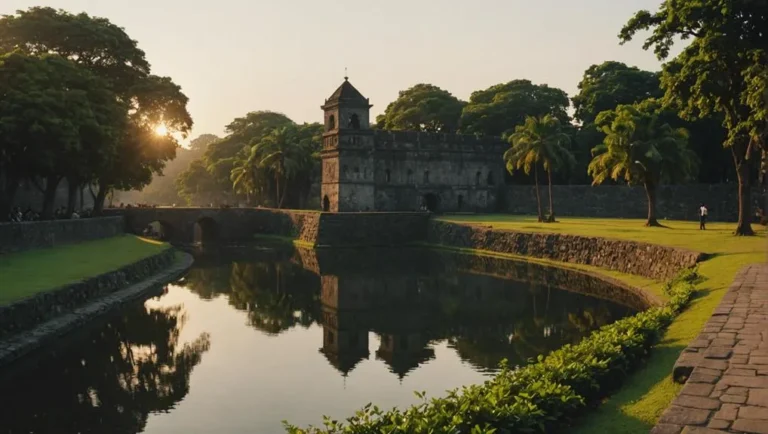
Discover Fort Santiago Philippines

Fort Santiago is the historic stone citadel that guards the mouth of the Pasig River in Intramuros, the walled old city of Manila. Built by the Spanish more than four centuries ago, it has witnessed the whole sweep of Philippine history, from colonial rule to the final days of national hero Jose Rizal. Today it is a beautifully preserved landmark and shrine, one of the most meaningful heritage sites in the country. This guide explains what Fort Santiago is, its history, and what visitors can see.
Intramuros, Manila
Spanish colonisers (late 1500s)
The mouth of the Pasig River
Rizal’s final imprisonment
Rizal Shrine and brass footsteps
Historical park and shrine
What Fort Santiago is
Fort Santiago is a defensive fortress at the northwestern tip of Intramuros, the historic walled city of Manila. Positioned where the Pasig River meets Manila Bay, it was the key to controlling the city and its harbour. Its thick stone walls, arched gate, and quiet courtyards make it both a monument to the colonial past and a peaceful green space in the heart of the modern capital. For Filipinos, it is above all a place of memory, forever linked to the nation’s struggle for freedom.
A fortress built to rule
The Spanish founded Fort Santiago in the late sixteenth century, on the site of an earlier settlement of the local ruler Rajah Sulayman. Made of stone and designed to command the river and bay, it became the seat of Spanish military power in the Philippines and the anchor of Intramuros. Over the centuries its dungeons and walls held prisoners, guarded the colony against attack, and served successive rulers. Its very stones tell the story of foreign domination, and of the Filipinos who resisted it.
Jose Rizal’s last steps
Fort Santiago’s deepest significance comes from Jose Rizal, the country’s national hero. It was here that Rizal was imprisoned in 1896 in the days before his execution for inspiring the movement against Spanish rule. In his cell he wrote his famous farewell poem, Mi Ultimo Adios. On the morning of 30 December 1896 he walked from the fort to nearby Bagumbayan, now Rizal Park, to face a firing squad. That final walk is marked today by a trail of brass footsteps set into the ground, tracing his path from prison to martyrdom.
Trials of war and rebirth
Fort Santiago suffered greatly in the twentieth century. During the Second World War the fort was used by occupying forces, and approximately 600 bodies were found in and around a dungeon after the Battle of Manila. Intramuros Administration notes that archaeological evidence disproves stories that the dungeons flooded with Pasig River water at high tide. In the decades since, the fort has been carefully restored as a historical park and shrine. Its revival stands as a symbol of resilience, a place where a painful past is preserved so that it may be remembered and honoured rather than forgotten.
What to see at Fort Santiago
A visit to Fort Santiago blends history, memorial, and quiet beauty. Highlights include the following.
- The main gate, a grand arched entrance carved with the image of Saint James (Santiago).
- The Rizal Shrine, a museum in the building where Rizal was held, displaying his belongings and writings.
- The brass footsteps, marking Rizal’s final walk to his execution.
- The dungeons and ramparts, sobering reminders of the fort’s darker chapters.
- Plaza Moriones and the gardens, peaceful lawns and fountains within the walls.
- Views of the Pasig River, from the spot that once controlled the whole city.
Tips for visiting
Fort Santiago sits at the heart of Intramuros and is easily combined with the rest of the old city. Go in the cooler morning or late afternoon, wear comfortable shoes for the cobblestones, and allow time to read the plaques that bring the history to life. Many visitors explore Intramuros by the horse-drawn kalesa, a charming way to see nearby San Agustin Church and Manila Cathedral. Together they make a rich half-day journey into the Philippines’ colonial past.
Exploring the rest of Intramuros
Fort Santiago is the crown jewel of Intramuros, but the whole walled city is a living museum worth exploring. Built by the Spanish as their seat of power in the Philippines, Intramuros is a district of cobbled streets, ancient walls, and grand churches.
- San Agustin Church, the oldest stone church in the country and a UNESCO World Heritage Site.
- Manila Cathedral, a magnificent basilica rebuilt many times over the centuries.
- Casa Manila, a museum recreating an elegant Spanish-era colonial home.
- The city walls and bastions, which you can walk for views over old Manila.
Touring Intramuros by horse-drawn kalesa or by bamboo bicycle is a popular way to soak up the atmosphere, and Fort Santiago makes the natural starting point for the journey.
Why Fort Santiago matters to Filipinos
For Filipinos, Fort Santiago is far more than an old fortress; it is hallowed ground in the story of the nation’s freedom. Its link to Jose Rizal makes it a place of pilgrimage, where students, families, and visitors come to honour the hero who gave his life for his country. The writings of Rizal helped awaken a nation, and here in his final prison those ideas met their ultimate sacrifice. To walk through Fort Santiago is to feel the weight of that history and the depth of the Filipino longing for liberty.
Planning your visit
Fort Santiago welcomes visitors, but admission fees and operating hours can change. Check the current Fort Santiago or Intramuros Administration notice before travelling. Allow roughly one to two hours for the fort and Rizal Shrine, wear comfortable footwear for the old stone paths, and bring sun protection for exposed areas.
A place where history comes alive
Few sites in the Philippines let you stand so close to the events that shaped the nation. Within Fort Santiago’s weathered walls, the layers of history feel almost tangible: the ambitions of Spanish colonisers, the quiet courage of Jose Rizal in his final hours, the suffering of the wartime years, and the resilience of a people who restored their heritage from ruins. School groups come to learn, families come to remember, and travellers from abroad come to understand how the Filipino nation was forged. More than a fortress or a museum, Fort Santiago is a bridge between past and present, inviting every visitor to reflect on the price of freedom and the enduring spirit of the Filipino people.
Whether you are a history enthusiast, a student of Rizal, or simply a traveller seeking to understand the Philippines, a visit to Fort Santiago belongs at the top of your Manila itinerary. It is a place that rewards quiet reflection, and one that stays in the memory long after you have left its ancient gates behind.
Frequently Asked Questions
Where is Fort Santiago?
It stands in Intramuros, the walled historic district of Manila, at the point where the Pasig River meets Manila Bay.
Why is Fort Santiago important?
It was a key Spanish fortress for centuries and is best known as the place where national hero Jose Rizal was imprisoned before his execution in 1896.
What can you see at Fort Santiago today?
The Rizal Shrine museum, the brass footsteps marking his last walk, the historic gate and dungeons, and peaceful gardens within the old walls.
Who built Fort Santiago?
The Spanish built it in the late 1500s, on the site of an earlier settlement, as the military stronghold of colonial Manila.
Conclusion
Fort Santiago is where the story of the Philippines is written in stone. From a symbol of colonial power to the final prison of Jose Rizal, it holds both the pain and the pride of the nation’s past. Walking its ramparts and following Rizal’s brass footsteps, visitors touch the very history that shaped the Filipino people.
Another key Spanish fortress in Philippine history is Fort San Felipe in Cavite, the site of the pivotal 1872 Cavite Mutiny.