Discover the Indigenous Tribes of the Philippines
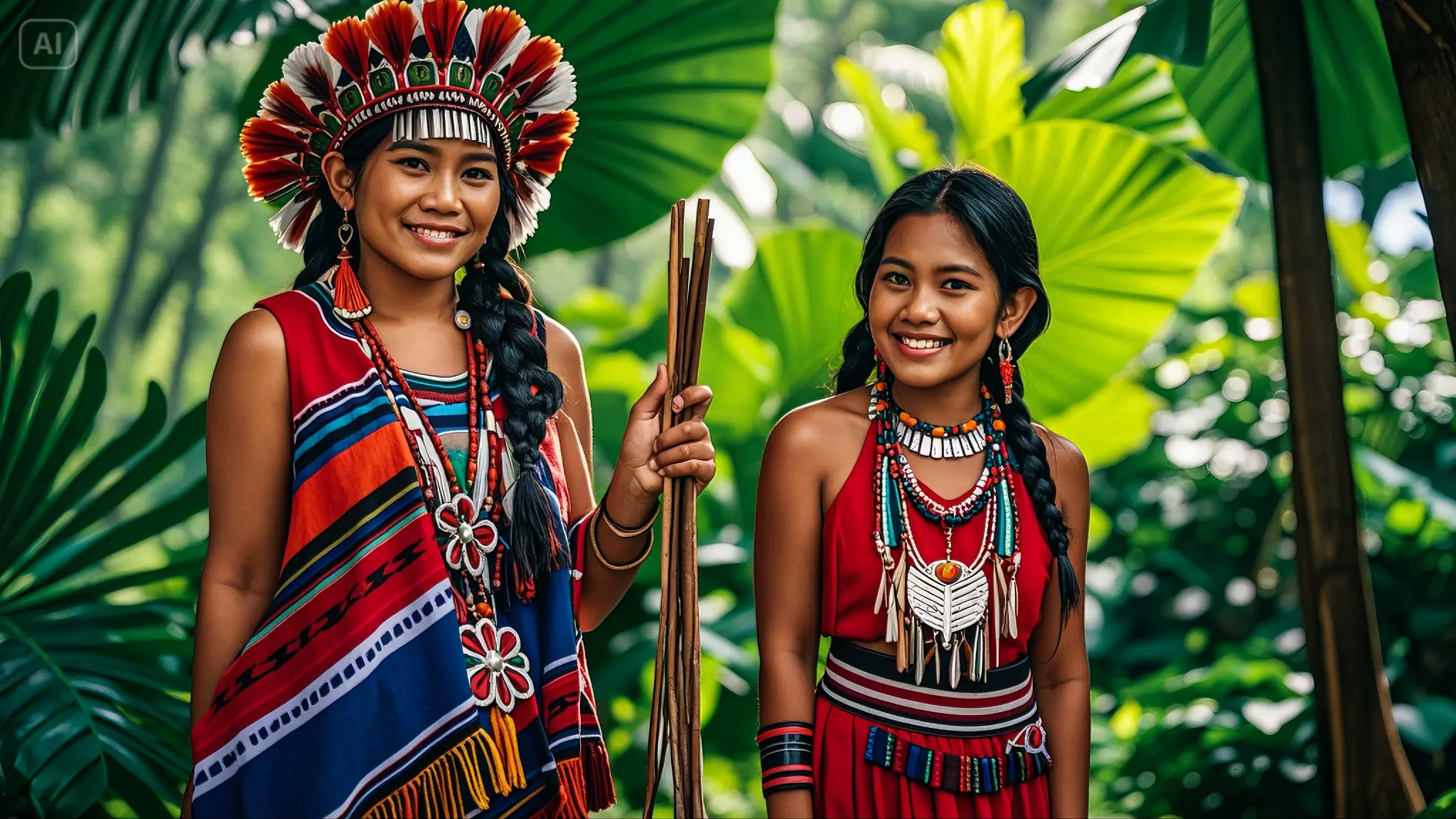
The Philippines counted 9,841,785 Indigenous Filipinos in the 2020 census, spread across roughly 110 ethnolinguistic groups from the Cordillera mountains to the Sulu Archipelago. Indigenous traditions here are not museum pieces. Batok tattooists still tap ink into skin in Kalinga villages, Ifugao farmers still ask the rice guardian Bulul for a good harvest, and Maranao singers still perform a 72,000 line epic at weddings.
This guide moves past name lists to look at what indigenous traditions actually involve today: oral epics, tattoo practice, rice terrace ritual, weaving, and the law that governs ancestral land. It also untangles three terms people often blur together: Lumad, Moro and Cordilleran peoples, since each names a distinct set of communities with its own history and legal status.
At a Glance
| Fact | Detail |
|---|---|
| Population counted, 2020 census | 9,841,785 Indigenous Filipinos, per the Philippine Statistics Authority |
| Ethnolinguistic groups | About 110 nationwide |
| Three broad groupings | Cordilleran peoples (Luzon), Lumad (Mindanao, non-Muslim), Moro peoples (Mindanao and Sulu, Muslim) |
| Governing law | Indigenous Peoples’ Rights Act of 1997, Republic Act No. 8371 |
| Lead government agency | National Commission on Indigenous Peoples (NCIP) |
| UNESCO recognized traditions | Hudhud chants, Darangen epic, Rice Terraces of the Philippine Cordilleras |
| Regional distribution | Roughly 63 percent in Mindanao, 34 percent in Luzon, 3 percent in the Visayas |
| Primary regions | Cordillera Administrative Region, Mindanao highlands, Sulu Archipelago, scattered Luzon lowlands |
Key point
Indigenous traditions in the Philippines are living practices, not relics. Communities in Kalinga, Ifugao, Lanao and Mindanao carry them forward today, adapted but unbroken across generations.
Lumad, Moro and Cordilleran: Three Terms, Not One Tribe
Filipino indigenous identity splits into three broad groupings, and mixing them up is a common mistake. Cordilleran peoples, once labeled Igorot, live across the mountain provinces of Northern Luzon. Lumad refers only to the non-Muslim, non-Christianized indigenous peoples of Mindanao. Moro peoples are the Islamized ethnolinguistic groups of Mindanao, Sulu and Palawan, and NCIP does not classify every Moro group as indigenous in the same legal sense.
The word Lumad is Bisayan for native, and Mindanao’s non-Muslim communities adopted it themselves in the 1980s to replace older colonial labels. It now covers at least 18 ethnolinguistic groups, including the Manobo, T’boli, B’laan and Subanen. Moro, a term communities later reclaimed with pride, covers the Maranao, Maguindanao, Tausug, Yakan and Sama, who together number more than 5 million people.
Three groupings, three histories:
- Cordilleran peoples: indigenous groups of Northern Luzon’s mountain provinces, including the Ifugao, Kalinga, Bontoc, Kankanaey and Ibaloi.
- Lumad: non-Muslim, non-Christianized indigenous peoples of Mindanao, at least 18 groups including the Manobo, T’boli and B’laan.
- Moro peoples: Islamized ethnolinguistic groups of Mindanao, Sulu and Palawan, including the Maranao, Maguindanao, Tausug and Yakan.
Population figures for each group vary by source, since the census and NCIP estimates do not always agree. The table below uses conservative, rounded figures.
Terminology carries weight here. Many communities prefer “Indigenous Peoples” or their own ethnonym over “tribe,” a word colonial administrators used to imply primitiveness. NCIP’s own working term is Indigenous Cultural Communities and Indigenous Peoples, shortened to ICCs/IPs in government documents, and that phrasing is worth using over the older word when writing about them.
Major Groups by Island Region
| Group | Homeland | Population (estimate) | Known For |
|---|---|---|---|
| Cordilleran peoples | Cordillera Administrative Region, Northern Luzon | roughly 1.5 million | Rice terraces, batok tattooing, hudhud chants |
| Aeta and Agta | Zambales, Bataan, Sierra Madre, scattered Luzon | tens of thousands | Among the Philippines’ earliest inhabitants |
| Mangyan | Mindoro | roughly 200,000 | Hanunoo and Buhid syllabic scripts, upland farming |
| Ati and Tumandok | Panay Island, Visayas | tens of thousands | Ati-Atihan Festival origins, oral storytelling |
| Lumad (18+ groups) | Mindanao highlands | estimates range from 2 million to over 4 million | Kulintang music, T’nalak weaving, communal land use |
| Moro peoples | Mindanao, Sulu Archipelago, Palawan | more than 5 million | Darangen epic, Islamic-indigenous synthesis, weaving |
Oral Epics Still Performed Today
Two Philippine epics carry UNESCO’s highest cultural recognition, and both are still performed rather than only archived. The Hudhud chants of the Ifugao were proclaimed a Masterpiece of the Oral and Intangible Heritage of Humanity in 2001 and formally inscribed on UNESCO’s Representative List in 2008. Ifugao chanters recite more than 200 individual hudhud during rice planting, harvest and funeral wakes, and a full recitation can stretch across several days.
The Darangen epic of the Maranao people runs even longer: 17 cycles and about 72,000 lines, proclaimed in 2005 and formally inscribed by UNESCO in 2008. Specialized male and female performers sing it over several nights at weddings around Lake Lanao. Maranao elders still cite the Darangen when settling disputes under customary law, since it encodes ideas about governance that predate the region’s conversion to Islam.
This is indigenous oral tradition working the way it always has: memory carried by trained voices, not paper. Ifugao and Maranao epics carry UNESCO status, but they are not alone:
- Ullalim: sung by Kalinga communities during peace pacts and courtship.
- Ulahingan: a long epic cycle maintained by Manobo groups in Mindanao, only partially documented by ethnographers.
Neither has UNESCO recognition yet, largely because inscription requires a formal nomination process that under-resourced communities rarely have the staff or funding to pursue.
Batok: Tattooing as Identity, Not Souvenir
Batok is hand tapped tattooing practiced across Cordilleran communities for more than a thousand years. A mambabatok, or tattoo practitioner, taps a thorn tied to a stick, dipped in soot and water, into the skin, line by line. The marks historically recorded a warrior’s victories, a woman’s weaving skill, or a family’s status, and different Cordilleran groups used different motifs for the same idea.
Whang-od Oggay, a Butbut Kalinga practitioner working from Buscalan village in Kalinga province, is the tradition’s best known living carrier. The National Commission for Culture and the Arts gave her its 2018 Dangal ng Haraya award, its first Lifetime Achievement honor for a folk artist rather than an academically trained one.
She broke with precedent by training women, including her grand niece Grace Palicas, since batok had traditionally passed through male family lines only. These traditional indigenous tattoos still carry the meanings they always did, even as the audience for them has changed.
Tip
Visiting Buscalan to get tattooed is popular, but the village asks visitors to book through registered guides, accept that some designs stay reserved for community members, and remember this is a living community, not a photo backdrop.
Motifs follow a shared vocabulary across Cordilleran groups:
- Centipede and python patterns commonly signal protection or fertility.
- Dots and connected lines mark rank earned through a specific deed, not decoration chosen freely.
University linguists and NCCA folklore units have documented these motifs alongside epic chants since the 1970s, since both skill sets are concentrated in a shrinking number of elder practitioners.
Rice Terraces and the Rituals That Built Them
The Rice Terraces of the Philippine Cordilleras became a UNESCO World Heritage Site in 1995, the first cultural landscape ever inscribed on that list. Ifugao farmers carved the terraces into mountainsides using stone walls and irrigation channels that draw water from forests above. UNESCO’s account dates the earliest terracing to roughly 2,000 years ago, though recent archaeological research suggests some sections may be closer to 400 years old, expanded partly as a response to Spanish incursions.
Farming here still follows a ritual calendar, not just a planting schedule. A mumbaki, or ritual priest, leads baki ceremonies asking Bulul, the carved rice guardian figures kept in Ifugao granaries, to protect the harvest. The Punnuk tug of war, held in Hungduan after the rice is in, joined UNESCO’s Intangible Cultural Heritage list in 2015 as part of a shared tugging tradition recognized across several countries.
The Banaue Rice Terraces are the best known example, though UNESCO’s inscription actually covers five separate clusters across Ifugao province, each maintained by the community that farms it:
- Batad
- Bangaan
- Hungduan
- Mayoyao
- Nagacadan
Rice ritual is not unique to the Ifugao. Kankanaey and Ibaloi communities hold cañao, a ritual feast marking harvest, marriage or a family’s rise in status, often built around communal food and days of shared labor. Kalinga farmers in some areas still time planting to the call of a specific bird, a practice ethnographers first recorded in the early twentieth century and that some elders still follow.
Weaving, Music and Everyday Craft
Textile weaving remains one of the most visible indigenous traditions in the Philippines, and each group ties its patterns to a different meaning. The T’boli of South Cotabato weave T’nalak from abaca fiber, dyeing patterns that weavers describe as coming to them in dreams. Kalinga and Ifugao weavers work backstrap looms into geometric designs once reserved for specific social ranks.
Yakan weaving from Basilan uses a different palette entirely: dense, brightly colored geometric bands worn during weddings and other formal occasions. Music carries similar regional variation. The kulintang, a set of eight tuned gongs, anchors ceremonial music for both Moro and Lumad communities in Mindanao, while the kudyapi, a two stringed boat lute, accompanies storytelling among Manobo and other Lumad groups.
Traditional indigenous family dwellings follow the same environmental logic as the crafts:
- Ifugao families live in a fale, a single room house on posts built without nails.
- Badjao families in the Sulu Sea raise stilt houses over tidal flats.
- Mangyan households in Mindoro build split bamboo homes suited to the island’s slopes.
Cordilleran groups also produce elaborate beadwork worn during rituals and rites of passage. Bead color and arrangement can signal clan and marital status, and Kalinga and Bontoc families still pass down old glass trade beads through generations rather than buying new ones.
Belief Systems: Animism, Islam and Christian Overlap
Most Cordilleran and Lumad communities practice animist belief systems centered on anito, ancestral and nature spirits addressed through ritual specialists rather than a single clergy. A ritual leader mediates between the community and these spirits during planting, healing and life passage rites. These beliefs were never fully replaced by colonial religions. They layered underneath them instead.
Moro peoples layered Islam onto existing indigenous frameworks rather than discarding them outright. Maranao and Maguindanao communities are Muslim by faith, but epics like the Darangen and pre-Islamic customary law still shape how disputes get settled and how status gets recognized. That layering is why lumping Moro identity in with either “indigenous” or simply “Muslim Filipino” loses the real picture. They are Islamized indigenous peoples of a specific place, not converts who left their earlier culture behind.
Aeta and Mangyan communities sit outside all three groupings above and hold their own animist systems, built around forest and mountain spirits rather than fixed settlement. Aeta groups in particular have historically practiced foraging and small scale hunting, which shapes a relationship to land that does not always map cleanly onto the settled ancestral domain model IPRA was written around.
Ancestral Domain and the Law Behind It
Republic Act No. 8371, also known as the Indigenous Peoples’ Rights Act of 1997, is the legal foundation for everything above. It created the National Commission on Indigenous Peoples, or NCIP, as the agency responsible for recognizing ancestral domains and enforcing indigenous rights. Before IPRA, most ancestral land had no formal legal status. Communities held it under customary law that Philippine courts did not automatically honor.
IPRA does four specific things:
- Recognizes ancestral domains through a Certificate of Ancestral Domain Title, based on continuous occupation rather than paper deeds.
- Requires free, prior and informed consent before mining, logging or other projects can enter ancestral land.
- Applies customary law first when resolving disputes among Indigenous Cultural Communities and Indigenous Peoples.
- Protects cultural and intellectual property, covering things like the Darangen epic and T’nalak weaving patterns as community property.
Enforcement lags behind the law’s intent. NCIP itself acknowledges that title processing faces delays and underfunding, and Lumad and Cordilleran communities alike still report permits granted without proper consent.
NCIP is unusual among Philippine agencies because Indigenous Peoples themselves select its seven commissioners, one per ethnographic region. That structure is meant to keep the agency answerable to the communities it serves rather than to Manila alone, though critics argue funding decisions still run through the national budget process.
Note
Ancestral domain is not the same as ancestral land. A domain covers a community’s shared territory, forests and waters included. A land title covers an individual or family’s specific plot inside that domain.
Living Traditions Under Pressure
Threats to these traditions are current, not historical. Lumad communities in Mindanao report a large share of the country’s land conflict cases, tied to mining and plantation expansion inside titled ancestral domains. Cordilleran communities have fought hydropower and mining proposals in Kalinga and Abra for decades, using the same free, prior and informed consent process IPRA created.
Moro communities in the Bangsamoro Autonomous Region navigate an added layer, aligning ancestral domain claims with the region’s own autonomous government structures. Cultural loss compounds land loss elsewhere: fewer young Ifugao now learn the full hudhud cycle as families move toward wage labor, and several Cordilleran languages are considered endangered by linguists. NCCA and NCIP run apprenticeship and documentation programs meant to slow that decline, pairing elders with paid trainees in weaving, chanting and ritual practice.
What Comes Next
None of this is static folklore. NCIP data, UNESCO listings and the tattoo queue in Buscalan all point the same direction: these communities keep their practices in active use, adapted by the people who hold them rather than preserved by outsiders on their behalf. Cordilleran, Lumad and Moro communities face real pressure from mining, land disputes and slow bureaucracy, but the epics are still sung, the terraces are still farmed, and the ink is still tapped by hand.
Weaving, tattooing and epic chanting sit inside a much wider set of Philippine traditions still practiced across the archipelago today, and that category page is a good next stop.
Frequently Asked Questions
What are the indigenous traditions of the Philippines?
They include animist ritual, oral epics like the hudhud and Darangen, hand tapped batok tattooing, backstrap and abaca weaving, and communal land stewardship under ancestral domain law. Practices vary sharply by group, since a Kalinga tradition is not a Maranao one.
How many indigenous groups are there in the Philippines?
NCIP and academic sources count around 110 ethnolinguistic groups nationwide. The Philippine Statistics Authority recorded 9,841,785 Indigenous Filipinos in the 2020 census, though NCIP and independent researchers estimate the true number is higher due to undercounting in remote areas.
What is the difference between Lumad and Moro peoples?
Lumad refers to non-Muslim, non-Christianized indigenous peoples of Mindanao, at least 18 groups including the Manobo and T’boli. Moro peoples are the Islamized ethnolinguistic groups of Mindanao, Sulu and Palawan, such as the Maranao and Tausug. Both are indigenous to Mindanao, but their religious and legal histories diverge sharply.
Is batok tattooing still practiced today?
Yes. Whang-od Oggay and the apprentices she trained, including her grand niece Grace Palicas, continue hand tapped batok in Buscalan, Kalinga. The National Commission for Culture and the Arts recognized the practice with a Dangal ng Haraya award in 2018.
What does the Indigenous Peoples’ Rights Act protect?
Republic Act No. 8371 recognizes ancestral domains, requires free and prior informed consent before development projects enter indigenous land, and applies customary law to disputes among Indigenous Cultural Communities. The National Commission on Indigenous Peoples enforces it, though implementation remains inconsistent.
Where can visitors experience these traditions respectfully?
Buscalan in Kalinga and the Ifugao rice terrace villages both welcome visitors through registered community guides who set the rules on photography, dress and which spaces stay off limits. Booking through those guides, rather than informal fixers, sends payment directly to the community and follows protocols the community itself set.
Works Cited
“Republic Act No. 8371.” Official Gazette, Republic of the Philippines, 29 Oct. 1997, www.officialgazette.gov.ph/1997/10/29/republic-act-no-8371/.
“Hudhud Chants of the Ifugao.” Intangible Cultural Heritage, UNESCO, n.d., ich.unesco.org/en/RL/hudhud-chants-of-the-ifugao-00015.
“Darangen Epic of the Maranao People of Lake Lanao.” Intangible Cultural Heritage, UNESCO, n.d., ich.unesco.org/en/RL/darangen-epic-of-the-maranao-people-of-lake-lanao-00159.
“Rice Terraces of the Philippine Cordilleras.” UNESCO World Heritage Centre, UNESCO, n.d., whc.unesco.org/en/list/722/.
“Celebrated Kalinga Tattoo Artist Apo Whang-Od to Receive NCCA Award.” Inquirer.net, 12 June 2018, lifestyle.inquirer.net/296986/celebrated-kalinga-tattoo-artist-apo-whang-od-receive-ncca-award/.
“Indigenous Peoples in the Philippines.” IWGIA, International Work Group for Indigenous Affairs, n.d., www.iwgia.org/en/philippines.html.