Tuna Festival: General Santos City’s Catch of the Year
The Tuna Festival in General Santos City is an industry-based civic celebration that recognises the people, businesses and public institutions connected with the city’s tuna economy. It is held in September, but its exact duration, venues and activities are approved for each edition rather than fixed permanently.
The 2026 festival is taking place from 1 to 5 September during the city’s recovery from the magnitude-7.8 earthquake of 8 June. General Santos City chose a smaller programme with a reduced budget, fewer major entertainment events and additional safety coordination. This article separates that current edition from the festival’s longer history so future readers do not mistake a one-year recovery programme for the usual format.
Tuna Festival facts at a glance
| Detail | Verified information |
|---|---|
| Location | General Santos City, SOCCSKSARGEN, Mindanao |
| Festival season | September; exact programme dates require annual confirmation |
| Documented beginning | 1998, according to the Philippine Information Agency’s 25th-year account |
| Purpose | To recognise the city’s tuna industry, its workers and connected civic identity |
| 2026 dates | 1 to 5 September 2026 |
| 2026 organiser | GenSan Tourism Council, as identified by the official event listing |
| Documented activities | Sugbahan sa Dalan, Fish Fest and other edition-specific tourism events |
| Primary orientation points | General Santos City Hall area and General Santos City Fish Port Complex |
The table is a factual guide, not a reusable itinerary. A tourism page, executive order or dated city announcement should control the plan for the year you intend to visit. Do not copy a previous route, starting time, ticket condition or event list into a later edition.
What the Tuna Festival celebrates
The festival’s name is direct: it identifies the tuna industry most closely associated with General Santos City. The official GenSan Tourism site describes the city as the Tuna Capital of the Philippines and says it has one of Asia’s largest fish ports. Its fish-port visitor listing presents the daily unloading, weighing and grading of tuna for export as a defining local experience.
That industrial setting is central to the festival’s meaning. Tuna reaches the public only through the work of fishing crews, fish-port labourers, graders, cold-chain personnel, processors, traders, cooks, transport workers and regulators. The celebration creates public space for parts of that working system, but it does not turn an active port into an unrestricted attraction.
The Philippine Statistics Authority’s January 2026 release helps explain the industry’s regional scale without relying on promotional estimates. For the third quarter of 2025, South Cotabato, including General Santos City, contributed 66,509.02 metric tons or about 89.5 percent of SOCCSKSARGEN’s fisheries production. The same release reported that the area accounted for 99.5 percent of the region’s commercial fisheries production during that quarter. These are dated regional statistics, not a claim that every tonne passed through one port or that the same percentage applies permanently.
The festival’s documented beginning in 1998
The Philippine Information Agency’s history of the 25th Tuna Festival states that the celebration was born in 1998 to honour the bountiful seas and the industry that established General Santos as the country’s tuna capital. This supports 1998 as the documented starting year. Available primary accounts do not establish a single individual founder, so this guide does not assign one.
General Santos had already been a city for three decades. Republic Act No. 5412, approved on 15 June 1968, created the City of General Santos and remains the legal foundation for its charter history. Cityhood and the festival are related parts of local identity, but they are not the same event. The city charter predates the Tuna Festival by 30 years.
The festival developed as a public expression of an industry already shaping the city. Later editions added and changed activities as organisers worked with government offices, tourism bodies and industry stakeholders. A current GenSan Tourism listing names the GenSan Tourism Council as organiser for 2026. Earlier and future governance arrangements should be verified from their own official records rather than assumed to be identical.
Recurring ideas and changing programmes
A Tuna Festival programme can combine industry recognition, food, public performance, trade and civic gathering. Some activity names recur, but recurrence does not guarantee the same date, venue, route or access conditions.
Sugbahan sa Dalan
Sugbahan refers to grilling, while sa dalan places the activity on the street. PIA’s report on the 2023 edition records grilled tuna panga, or tuna jaw, together with shrimp and other seafood along Pioneer Avenue. It also states that the activity had been drawing residents and visitors annually since 2015. This documents the activity’s public food character and its place in recent festival history, not a guaranteed street or serving arrangement for every year.
Fish Fest and fish-port workers
For 2026, PIA specifically identifies Fish Fest at the General Santos City Fish Port as one of the retained activities. Festival Director Joey John Concepcion explained that it was intended to give the port’s jamboleros and jamboleras, workers already active in the early morning fish-port economy, a day to celebrate the industry of which they are part.
This emphasis matters. A responsible account of the Tuna Festival should describe workers as participants and economic stakeholders, not scenery around a seafood attraction. Visitors should follow port controls and avoid obstructing weighing, grading, loading or sanitation work.
Parades, culinary activity and public entertainment
The official GenSan Tourism event page for 2026 lists a Tuna Float Parade, Sashimi Night, Ocean Breeze Concert and Fish Port Tour among its highlights. Its general events page also refers to culinary competitions and street parties. Those labels describe the 2026 tourism listing only. PIA separately reports that several major entertainment events and appearances by national artists were removed after the festival budget was reduced. Travellers should therefore confirm a specific activity directly with GenSan Tourism instead of treating a short online highlights list as a complete revised schedule.
Tuna Festival 2026: recovery, safety and a smaller programme
The 2026 edition is unusual because it follows the magnitude-7.8 earthquake that struck General Santos City on 8 June. PIA reported on 1 September that the city decided to continue with a five-day festival under the theme “Giting at Pagkakaisa, sa Pagbangon Sama-sama,” translated as “Courage and Unity: Rising Together.” The theme connects the celebration with residents, frontliners and communities involved in recovery.
The city reduced the festival allocation from the usual ₱15 million cited by the festival director to ₱5 million for 2026. The adjustment removed several large entertainment components while preserving activities tied more closely to community and industry, including Sugbahan sa Dalan and Fish Fest. These budget figures and cancellations belong to 2026 and should not be reused as a description of another edition.
General Santos City’s Executive Order No. 49-2026, dated 18 August, authorised the celebration and the Bangon GenSan: Tuna Festival Recovery Night Market. The order’s title identifies support for earthquake-affected micro, small and medium enterprises as part of the night market’s purpose. This connects recovery policy with livelihood support without implying a measured economic outcome that has not yet been published.
Safety planning also changed. PIA states that the city notified the Office of Civil Defense and PHIVOLCS and was advised that activities could proceed with additional precautions. Police explained that concentrating activities near the City Hall area made the grounds more manageable. Visitors should still follow current instructions because access zones and precautions can change during an ongoing festival.
The fish port, tuna handling and public understanding
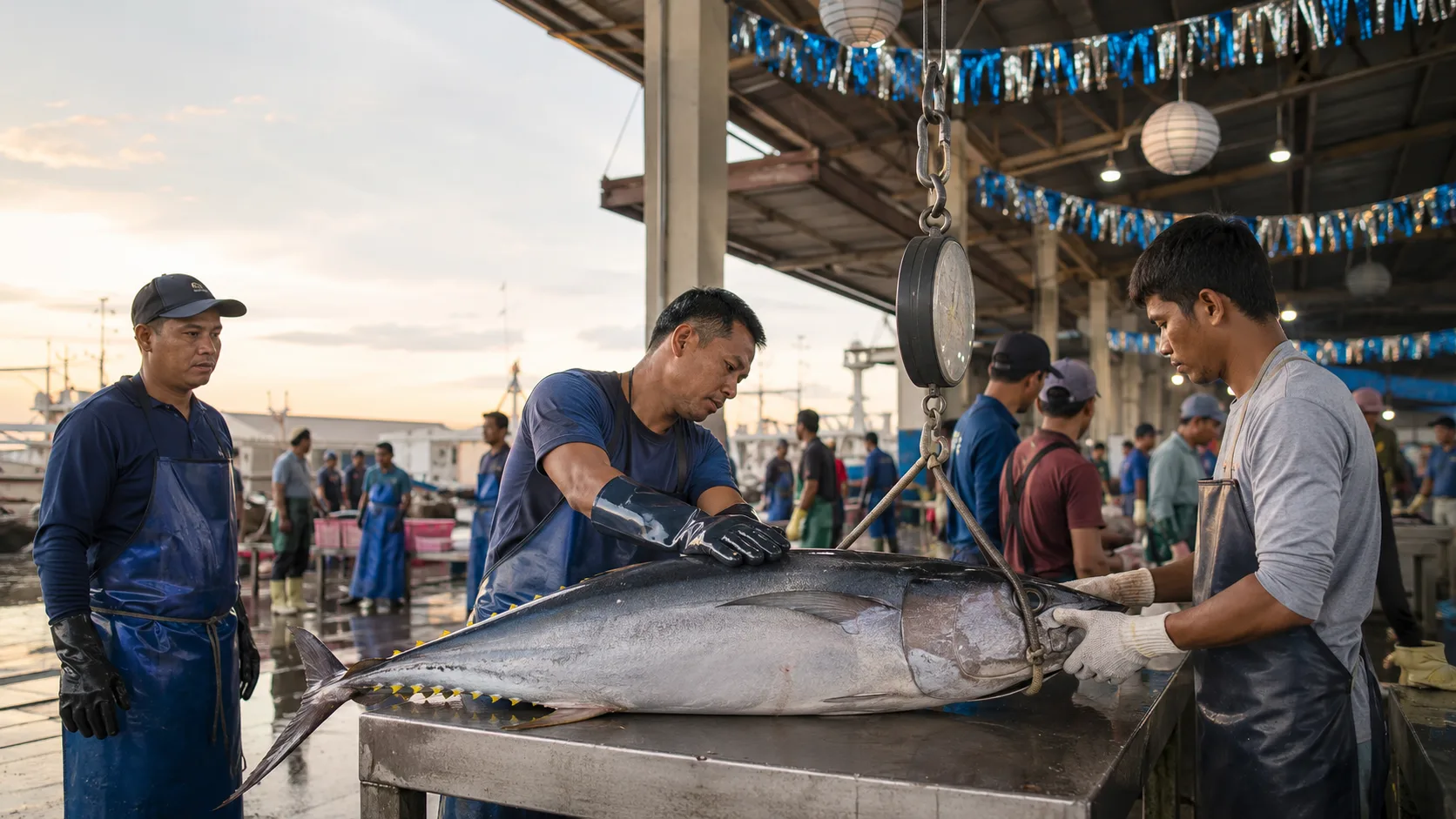
GenSan Tourism describes the General Santos City Fish Port Complex as a place where the daily catch is unloaded, weighed and graded for export. These steps reveal why tuna quality depends on coordinated handling rather than a single dramatic moment when a fish reaches the dock. The port also helps readers understand why the festival includes cooks, traders, processors and logistics workers alongside fishing crews.
The current tourism event page includes a fish-port tour among its 2026 highlights, but that does not establish open access throughout the complex. A working port can impose identification, clothing, sanitation, photography or group controls. Use the official tourism office to confirm whether a tour is operating, what part of the port it covers and whether advance registration is required.
For orientation, open the General Santos City Fish Port Complex on Google Maps. Treat the pin as geographic guidance only. Do not use it to enter a restricted gate or bypass an official assembly point.
Sustainability and traceability belong in the story
A festival can honour an industry while acknowledging the responsibilities that keep it viable. It is not necessary to declare one fishing method universally sustainable or to repeat unsourced claims about catch composition. Current public records provide a firmer basis for discussing management.
In September 2025, the General Santos Sangguniang Panlungsod recorded support for a catch documentation and traceability system connected with sustainable fisheries and tuna-industry management. The same council record supported rehabilitation of the fish-port complex and a fish-health and quality-control laboratory. These measures show that traceability, food safety and management are active civic concerns around the industry the festival celebrates.
For visitors, responsible participation is practical: buy from established vendors, follow food-safety instructions, avoid wasting seafood and do not make conservation claims based only on a menu label or costume theme. The people who catch, grade, prepare and regulate tuna should remain visible in the story.
Who participates and what the festival represents
The Tuna Festival brings together groups whose roles differ. Fish-port workers and fishing-industry businesses participate through activities linked to their work. Cooks and food vendors interpret tuna through preparation and service. Tourism and city bodies coordinate public activities. Residents attend a civic celebration, while performers and organisers contribute to the named programme for that year.
The 2026 edition also recognises earthquake responders and recovery communities. That focus is specific to the circumstances of the year. It should be documented without turning the disaster into a marketing device or suggesting that five festival days complete the city’s recovery.
Tuna Festival should also be distinguished from nearby celebrations. General Santos hosts Kalilangan in February, while South Cotabato holds the T’nalak Festival in July. Their histories and cultural purposes are not interchangeable. For a wider route through the region, see the Region 12 travel guide and the national Philippine festival calendar.
How to verify a changing festival programme
Start with the official GenSan Tourism event page because it identifies the edition, date range, organiser and inquiry channel. Then check the city’s executive-order archive for the legal authority and purpose of special initiatives. For 2026, the tourism listing confirms the five-day window, while Executive Order No. 49-2026 confirms the recovery night market and its support for earthquake-affected enterprises.
Next, look for later operational notices. A programme can change after an event page is created, particularly when safety, weather, transport or recovery conditions are involved. The 1 September PIA report is important because it records the reduced budget, cancelled entertainment components, retained industry activities and coordination with disaster agencies. A visitor should favour that newer, specific information over an undated promotional summary.
- Confirm that the source names the year and exact activity.
- Check whether a notice comes from the city, tourism council, police, disaster office or port authority responsible for the decision.
- Look for a later amendment, cancellation or venue notice before leaving for the site.
- Do not treat a social-media screenshot as official unless it leads back to a responsible authority.
- Save the organiser’s contact details and a secondary meeting point outside the busiest zone.
This method applies beyond General Santos. The Kadayawan guide and Bangus Festival guide also separate enduring cultural or industry context from the programme approved for one year.
Planning a respectful visit
- Confirm the named edition. Use the GenSan Tourism event page and later city notices that clearly state the year.
- Verify the activity, not only the festival dates. Ask whether a tour, parade, food event or concert remains in the revised programme.
- Separate City Hall and fish-port plans. They are different working areas and may have different entry controls.
- Allow for current safety measures. Follow police, disaster-response and event-marshal instructions immediately.
- Use flexible transport and accommodation. Do not rely on an old road closure, route or event start time.
- Ask vendors about ingredients. Grills and preparation areas may handle several seafood species and shared sauces.
- Carry essentials permitted by organisers. Water, weather protection, identification and necessary medicine are more useful than bulky bags.
The official tourism site lists the City Hall Compound as the tourism office location and provides current event and contact information. Use the General Santos City Hall map for orientation, then follow the event entrance and closure plan published for the day.
Etiquette at the port, food events and public activities
- Do not step into weighing, cutting, loading or vehicle lanes to take a photograph.
- Ask before making close portraits of workers, cooks or vendors.
- Never touch tuna, tools, ice, display surfaces or port equipment unless a guide explicitly permits it.
- Keep clear of performers, emergency corridors and staff access points.
- Dispose of food waste properly and avoid taking more than you can eat at a public serving activity.
- Do not describe every resident as a fisher or reduce the city to one industry.
- Ask organisers about accessible viewing, toilets and medical points because working port surfaces and temporary barriers may create obstacles.
Visual context
- Fish-port labour: Adult workers weigh and inspect a freshly landed yellowfin tuna on a stainless handling table at dawn.
- Street food activity: Cooks tend organised grills while diners remain behind the serving line during Sugbahan sa Dalan.
- Civic gathering: Residents move through a managed City Hall festival area while marshals preserve an emergency corridor.
Authoritative sources used
- GenSan Tourism’s Tuna Festival 2026 listing, plus its official city profile and fish-port experience listing
- Philippine Information Agency report on Tuna Festival 2026
- Philippine Information Agency record of Sugbahan sa Dalan and its 25th-year festival history
- General Santos City Executive Order No. 49-2026 archive entry
- Philippine Statistics Authority fisheries release for the third quarter of 2025
- Supreme Court E-Library copy of Republic Act No. 5412 and the General Santos City Council’s 2025 fisheries resolutions
Frequently asked questions
When is Tuna Festival 2026 in General Santos City?
The official GenSan Tourism listing gives 1 to 5 September 2026. The city is holding a reduced recovery-focused programme, so individual activities should be confirmed before travel.
When did the Tuna Festival begin?
The Philippine Information Agency’s 25th-year history identifies 1998 as the festival’s beginning. Available primary accounts do not establish one sole founder.
What does the Tuna Festival celebrate?
It recognises General Santos City’s tuna industry, including fish-port workers, fishing crews, processors, cooks, traders, businesses and the civic identity that developed around the industry.
What happens during the Tuna Festival?
Documented editions include industry, food and public activities such as Sugbahan sa Dalan and Fish Fest. Parades, tours, concerts, venues and access conditions depend on the official programme for that year.
Can visitors enter the General Santos City Fish Port during the festival?
The 2026 tourism listing includes a fish-port tour, but the port remains a working facility. Confirm authorised tour availability, registration, identification, clothing and photography rules with GenSan Tourism.
Last reviewed: 2 September 2026. Rebuilt the article with primary government sources, corrected cityhood and festival-history distinctions, removed unsupported permanent schedules and industry figures, added the current earthquake-recovery programme, worker and sustainability context, maps, etiquette, planning guidance, a documentary featured image and five visible fact-checked FAQs.
Update: 3 September 2026
Saturday, 5 September 2026, has been declared a special non-working day in General Santos City for the 28th Tuna Festival. The Presidential Communications Office announced the declaration on 2 September, saying it is intended to give residents an opportunity to participate in the celebration.
Proclamation No. 1410 was signed on 28 August and uploaded to the Official Gazette on 1 September. The holiday coincides with the festival’s closing day. Bombo Radyo GenSan separately reported the citywide declaration on 2 September.
The proclamation does not set operating hours for individual businesses, transport services or festival venues. Visitors should confirm opening times and travel arrangements directly before attending the closing-day activities.