What is Tagalog
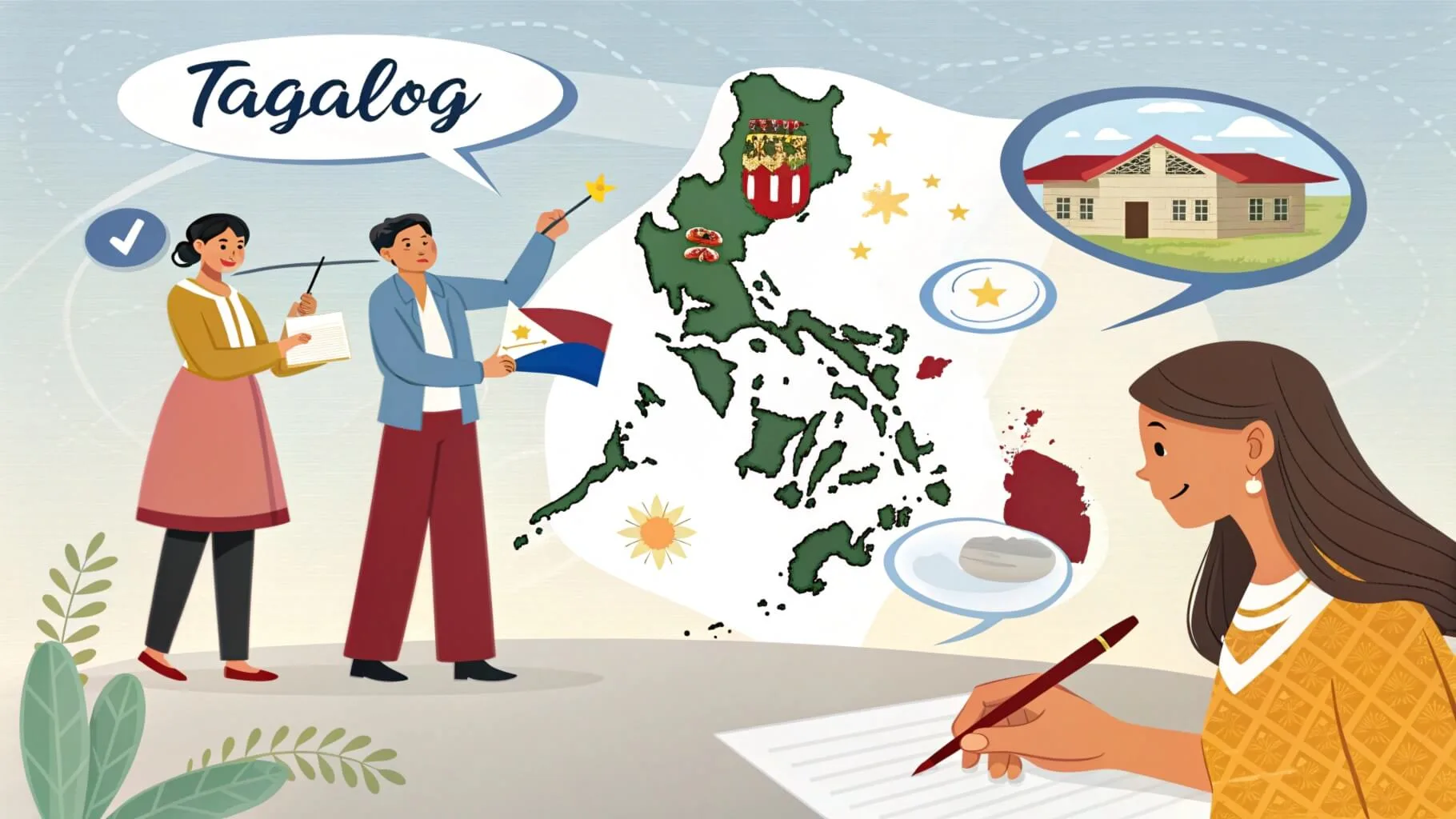
Tagalog is an Austronesian language native to central and southern Luzon, spoken as a first language by roughly 33 million people and understood by tens of millions more across the Philippines. It forms the base of Filipino, the country’s national language, though the two terms are not perfectly interchangeable.
Tagalog’s roots trace back nearly 4,000 years, to Austronesian-speaking migrants who reached the Philippines from Taiwan. That deep ancestry links Tagalog to languages as far apart as Malay, Indonesian, and Hawaiian, all branches of one of the world’s largest language families.
At a Glance: Tagalog
| What to know | Details |
|---|---|
| Language family | Austronesian, Central Philippine branch |
| Home region | Central and southern Luzon, including Manila |
| Speakers (first language) | About 33 million |
| Speakers (total, incl. second language) | 80 million or more |
| Old writing system | Baybayin |
| Basis of | Filipino, the national language |
| Closest relatives | Bikol, Cebuano, Hiligaynon, Waray |
Key point
Tagalog and Filipino are closely related but not the same thing. Tagalog is the regional mother language of central Luzon. Filipino is the standardized national language built on Manila Tagalog, designed to keep absorbing words from other Philippine languages.
Ancient Roots, Regional Home
Tagalog belongs to the Austronesian language family, believed to have originated in Taiwan before spreading across Southeast Asia and the Pacific. Speakers of these early languages reached the Philippines around 4,000 years ago, eventually settling and diversifying into the more than 170 languages spoken across the archipelago today.
Within that family, Tagalog sits in the Central Philippine branch, making it a close relative of Bikol and the Visayan languages, including Cebuano, Hiligaynon, and Waray. Long before Spanish contact, Tagalog speakers had already developed a rich oral tradition of poetry and song, along with their own writing system, baybayin.
Centuries of Borrowed Words
Tagalog absorbed vocabulary the way the Philippines absorbed trade partners and colonizers. Spanish missionaries documented the language in grammars and dictionaries during more than three centuries of colonization, leaving deep marks on everyday vocabulary. Sanskrit and Chinese words arrived earlier through trade, and English words have poured in more recently.
| Source language | Example borrowings | Era of influence |
|---|---|---|
| Sanskrit | Words for abstract and religious concepts | Pre-colonial trade contact |
| Spanish | Mesa (table), silya (chair), many others | 1565-1898 colonial period |
| Chinese | Trade and food-related terms | Centuries of maritime trade |
| English | Technology, pop culture terms | 20th century onward |
Many of these borrowings are so well absorbed that speakers no longer think of them as foreign words at all. A Tagalog sentence can mix a Spanish-derived noun, a Sanskrit-derived abstract term, and a recent English loanword without sounding unusual to a native ear, a layering that reflects centuries of overlapping contact rather than any single dominant influence.
How Tagalog Became a National Language
Tagalog’s rise to national status followed a specific legal process rather than simple popularity. The 1935 Constitution of the Philippine Commonwealth mandated development of a national language based on one of the country’s existing native languages, but it did not name Tagalog outright.
An Institute of National Language studied the country’s languages over the following two years and recommended Tagalog as the strongest candidate. President Manuel Quezon acted on that recommendation with Executive Order No. 134 in December 1937, formally proclaiming Tagalog as the basis of the national language.
Note
The national language changed names twice after that. It became “Pilipino” in 1959 to soften associations with one specific region, then “Filipino” under the 1973 Constitution, a designation the 1987 Constitution confirmed permanently.
Schools began teaching the Tagalog-based national language as a required subject in 1940, using a grammar book prepared by Lope K. Santos. That classroom rollout, not the earlier constitutional mandate on its own, is what actually spread the language into regions where it had never been spoken natively before.
Tagalog Versus Filipino Today
Article XIV, Section 6 of the 1987 Constitution states plainly that Filipino is the national language, and that it should keep evolving by drawing on other Philippine and world languages. In practice, Filipino remains built overwhelmingly on Manila Tagalog vocabulary and grammar.
A Tagalog speaker and a Filipino speaker understand each other completely, with no real barrier between the two in daily conversation. The practical difference shows up mostly in formal contexts: Filipino text absorbs loanwords more readily and represents itself as belonging to the whole country rather than to one region alone.
A Language Among Many
Not every Filipino speaks Tagalog as a first language, and treating it as though everyone does misreads the country’s makeup. The Philippines has more than 170 languages, including Cebuano, Ilocano, Hiligaynon, Bikol, Kapampangan, Pangasinan, and Waray, nearly all of them Austronesian like Tagalog itself.
- Cebuano: spoken widely across the Visayas and parts of Mindanao
- Ilocano: dominant across much of northern Luzon
- Hiligaynon: centered on Iloilo and western Visayas
- Kapampangan: spoken in Pampanga, central Luzon
Tagalog, through Filipino, provides a common thread tying these communities together, even as each region keeps its own language and identity fully alive.
What Makes Tagalog Distinctive
Tagalog’s grammar surprises many newcomers used to English sentence structure. Verbs change form through affixes to mark focus and aspect rather than simple tense, so a single root word can branch into a wide family of related verbs depending on what the sentence emphasizes.
Markers like ang, ng, and sa signal a word’s grammatical role, and reduplication, repeating part of a word, shifts meaning in predictable ways: araw, meaning day, becomes araw-araw, meaning every day. Politeness is grammatically built in too, through the particles po and opo.
Tip
Learn po and opo early if you are picking up Tagalog. Adding them to short phrases signals respect immediately, even before your grammar or vocabulary is fully solid.
Tagalog Beyond the Philippines
Migration carried Tagalog far past Luzon. Filipino communities in the United States, Canada, the Middle East, Europe, and Australia keep the language alive across generations, often ranking it among the more widely spoken non-English languages in their adopted countries.
For families abroad, Tagalog functions as more than communication. Parents use it to pass identity to children born far from the Philippines, through bedtime stories, holiday gatherings, and the small habit of reminding a child to say po to an elder. That transmission keeps the language a living part of diaspora life rather than a fading heritage marker.
- United States: one of the most common non-English languages in several states with large Filipino populations
- Middle East: widely spoken among overseas Filipino workers in Gulf countries
- Canada and Australia: growing use tied to steady Filipino immigration
- Europe: smaller but active communities maintaining Tagalog in the home
Note
Second-generation Filipino Americans and other diaspora children often grow up understanding Tagalog fully while speaking it less fluently than their parents, a common pattern in heritage language communities worldwide rather than something unique to Tagalog.
Tagalog in Daily Life and Culture
A handful of everyday words carry a traveler far: kumusta means how are you, salamat means thank you, oo and hindi mean yes and no. Many common nouns reveal Tagalog’s layered history directly, since mesa and silya come straight from Spanish while other trade-era words trace back to Chinese.
In cities especially, Filipinos often mix Tagalog and English within the same sentence, a practice nicknamed Taglish. Rather than signaling incorrect speech, it reflects a genuinely bilingual society and keeps the language absorbing new terms from technology and pop culture as quickly as they appear.
Tagalog also carries an enormous share of Filipino popular culture: films, teleseryes, comics, and music spanning old kundiman love songs to modern OPM. That cultural weight is a major reason the language spread well beyond its original Luzon home, reaching Filipino communities worldwide.
Frequently Asked Questions
What is Tagalog?
Tagalog is an Austronesian language native to central and southern Luzon, including Manila. It is the language on which Filipino, the national language of the Philippines, is based.
Is Tagalog the same as Filipino?
They are closely related but not identical. Filipino is the standardized national language built on Manila Tagalog, designed to keep absorbing words from other Philippine languages and English, while Tagalog refers more specifically to the regional mother language.
Where did Tagalog come from?
Tagalog descends from Austronesian languages that reached the Philippines roughly 4,000 years ago. It developed in the Manila region and absorbed words from Sanskrit, Chinese, Spanish, and English over centuries of trade and contact.
Do all Filipinos speak Tagalog?
Not as a first language. The Philippines has more than 170 languages, but Tagalog, as the basis of Filipino, is widely understood nationwide and serves as the country’s common language alongside English.
How many people speak Tagalog?
Roughly 33 million people speak Tagalog as a first language, with tens of millions more using it as a second language, bringing the total number of speakers worldwide to well over 80 million.
Tagalog’s old baybayin script and its role in belief systems like anito are two more threads in the same pre-colonial story. Browse History and Culture or Glossary for more Philippine language and heritage guides.