Singakaban Festival Bulacan: History & Activities
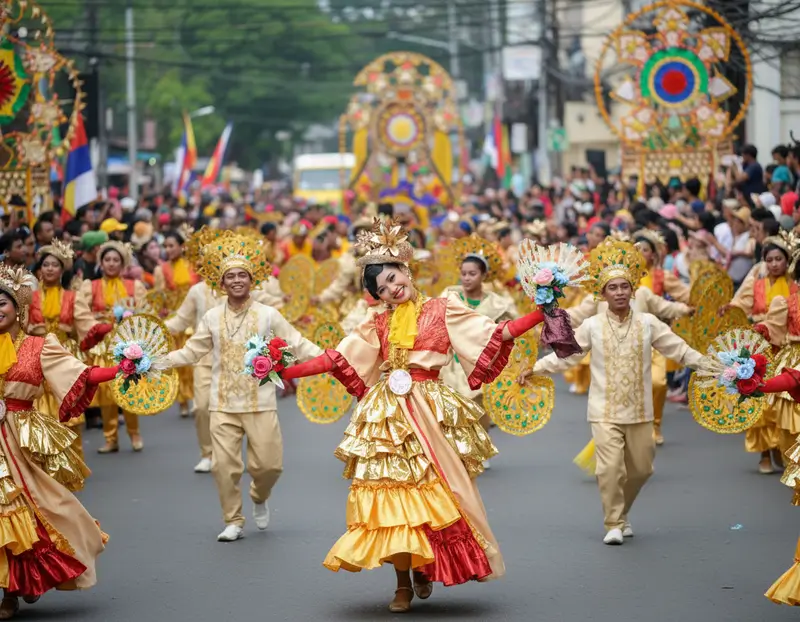
Bulacan marked its 448th founding anniversary on August 14, 2026, and that ceremony doubled as the official kickoff for that year’s Singkaban Festival. Search results and directories sometimes list the event as Singakaban Festival Bulacan, a variant spelling of the same celebration, Bulacan’s largest annual fiesta.
The festival began as Linggo ng Bulacan, or Bulacan Week, in 1986 under then-Governor Roberto Pagdanganan. It took the Singkaban name in 1993 and grew into a full week-long event by 1997, culminating each September around the anniversary of the 1898 Malolos Congress.
At a Glance: Singakaban Festival Bulacan
| What to know | Details |
|---|---|
| Location | Bulacan province, Philippines (centered on Malolos City) |
| Timing | Culminates mid-September, tied to the Malolos Congress anniversary |
| Founded | 1986 as Linggo ng Bulacan; renamed Singkaban in 1993 |
| Named for | Singkaban, a bamboo arch originating in Hagonoy |
| Signature events | Indakan sa Kalye, Parada ng Karosa, Gawad Dangal ng Lipi |
| Historical tie | 1898 Malolos Congress, held at Barasoain Church |
| Distance from Manila | About 30 kilometers |
Key point
An earlier version of this page gave two different founding years, 1986 and 1978. The correct year is 1986, when the event started as Linggo ng Bulacan under Governor Roberto Pagdanganan, confirmed by the festival’s official site.
From Bulacan Week to a Province-Wide Icon
Linggo ng Bulacan began as a modest two-day gathering. Provincial leaders expanded it in 1997 into a week-long celebration, a shift that tracked Bulacan’s growing role in how the country tells its own revolutionary history.
That history centers on the Malolos Congress. Delegates convened at Barasoain Church in 1898 under President Emilio Aguinaldo and drafted Asia’s first republican constitution, a milestone in Philippine independence that few other provincial festivals can claim as their own founding reference point. The festival’s culminating week each September marks that anniversary rather than a saint’s feast day or harvest season.
The Singkaban: Bulacan’s Bamboo Arch
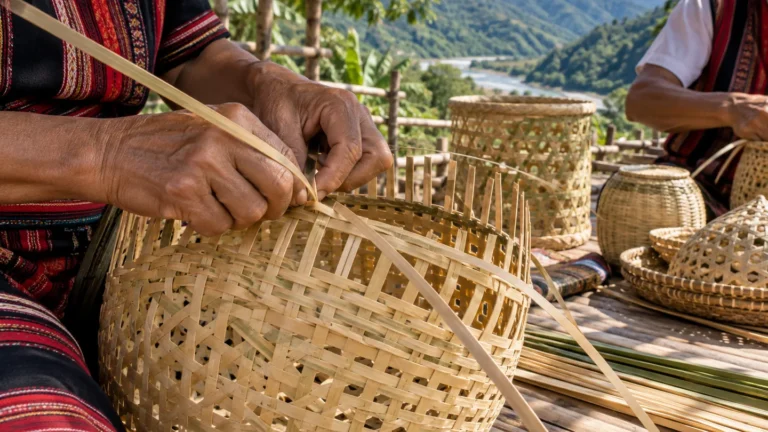
Every Singkaban Festival is named after a physical object: the singkaban, a bamboo arch that traditionally spans roads and church entrances during fiestas. The craft traces back to Hagonoy, a coastal Bulacan town where artisans developed the technique of shaving and curving bamboo for grand village celebrations.
Two distinct design schools have grown from that origin.
| Style | Town | Signature look |
|---|---|---|
| Malolos style | Malolos City | Flowing, curvilinear motifs |
| Hagonoy style | Hagonoy | Sharp, geometric patterns |
Building a singkaban takes seven to ten days from start to finish. Artisans first cure the bamboo to prevent cracking, then carve and shape it into components with their own names: rayos or bilog, the shaved sticks radiating from a central hub, and abaniko or pamaypay, the fan-shaped piece crowning the arch. A third element, bulakaykay, decorates the arch’s poles and often carries the most intricate carving of the entire structure.
Note
The National Museum’s own account of the craft documents the same design vocabulary artisans still use today, evidence of how consistently the technique has passed down through generations.
A Family That Kept the Craft Alive
Francisco “Kiko” Eligio of Hagonoy, a 2019 National Living Treasure awardee, became the best-known master of the palubid spiral technique used on singkaban poles. He taught the method directly to his grandsons, Jeffrey and Gerry Eligio, who continue building arches for the festival today.
That kind of direct, family-to-family transmission is rare for a craft this specialized. Schools in Bulacan now run workshops to teach the technique more broadly, partly to keep it from depending on a handful of families and partly in hopes of eventual UNESCO recognition for the art form.
Singkaban arches see use well beyond festival week. Over 50 provincial events use them annually, from weddings to smaller town fiestas, which means Hagonoy and Malolos artisans stay busy year-round rather than relying on a single September rush for income.
Gawad Dangal ng Lipi: Honoring Bulacan’s Own
Gawad Dangal ng Lipi recognizes at least 14 Bulakenyos each year for contributions to the province, spanning categories from healthcare to education to the preservation of traditional crafts like singkaban weaving itself. Past honorees have included healthcare workers recognized for pandemic-era service and artisans keeping bamboo craftsmanship alive in Hagonoy and Malolos.
The award functions as a counterweight to the festival’s competitive events. Where Indakan sa Kalye and Parada ng Karosa reward performance in the moment, Gawad Dangal ng Lipi recognizes a body of work built over years, giving the festival a civic dimension beyond pure spectacle and street performance.
Parada ng Karosa: Floats With a Point
Parada ng Karosa floats are judged on three criteria: cultural relevance, visual impact, and innovation. Past entries have recreated Malolos Church in miniature, built mosaics from pastillas candy wrappers, and incorporated moving parts and lighting rigs that push well past a simple decorated cart.
That judging structure pushes float builders toward substance over spectacle. A float with strong visuals but no clear cultural reference typically loses to a simpler design that ties directly to Bulacan’s history or local industries. Local business groups often sponsor entries, turning the parade into a showcase for provincial industry alongside its artistic competition, and past winners have leaned heavily on Bulacan’s food and craft exports for their themes.
Signature Events
Festival week packs competitions and ceremonies into a tight schedule, with mornings favoring contests and evenings favoring performance.
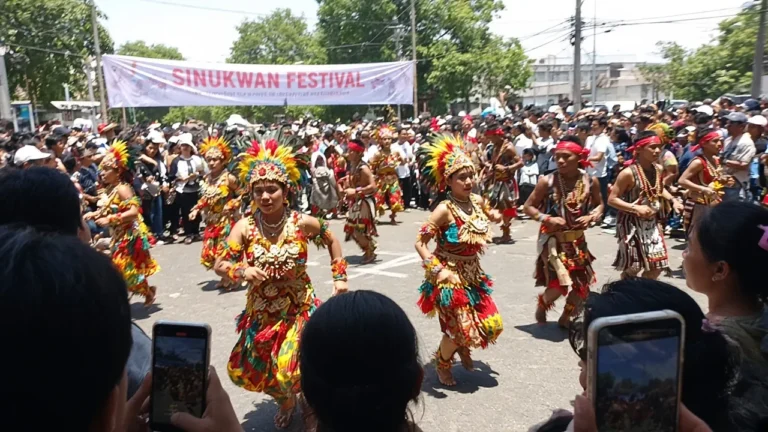
- Indakan sa Kalye: street dancing competition among municipal teams, judged on choreography and costume
- Parada ng Karosa: a float parade judged on cultural relevance, visual impact, and innovation
- Gawad Dangal ng Lipi: annual recognition for accomplished Bulakenyos, honoring 14 or more individuals each year
- Trade fairs, food festivals, and antique displays running alongside the main competitions
Tip
Book accommodations by June if you plan to attend in September. Hotel rates in Malolos and nearby towns rise as the festival approaches, and the best options sell out first.
Why the Festival Draws Repeat Visitors
Before the pandemic paused large gatherings in 2020 and 2021, Singkaban Festival drew tens of thousands of visitors during its September run, and the province leaned on that turnout to promote tourism beyond the festival week itself. The 2022 return after the hiatus was treated locally as a milestone, a signal that Bulacan’s largest civic event had survived intact.
Much of that draw comes from proximity. At roughly 30 kilometers from Manila, Bulacan offers a full province-wide festival experience without the multi-hour travel that events in the Visayas or Mindanao require. Day-trippers can catch a single event, such as Indakan sa Kalye, while visitors staying longer can work through the food fairs, exhibits, and float parade across several days.
Planning a Visit
Bulacan sits close enough to Manila for a day trip, though a multi-day visit makes more sense given how much runs during festival week.
- Confirm exact September dates through the provincial government’s official channels each year
- Budget for gala performances, some of which charge modest ticket prices
- Pack for warm, humid weather typical of a Philippine September
- Visit Barasoain Church separately from festival crowds for a quieter historical visit
Most Singkaban Festival events run at little or no cost to attendees, with only select gala performances charging admission. That accessibility is part of the province’s own pitch: a festival built for residents first, with visitors welcome to join rather than a ticketed spectacle designed primarily for tourists.
Tip
Pair a Singkaban Festival visit with a stop at Barasoain Church on a non-festival day. The church draws its own crowds during the celebration, and a quieter visit makes it easier to appreciate the building’s role in the Malolos Congress.
For more on the figure at the center of the Malolos Congress story, read our profile of Emilio Aguinaldo, and browse History and Culture for related coverage of the revolutionary period the festival commemorates.
Frequently Asked Questions
What is the Singakaban Festival?
Singakaban Festival Bulacan, more commonly spelled Singkaban, is the province of Bulacan’s week-long September celebration honoring the 1898 Malolos Congress and showcasing bamboo arch artistry, street dance, and local heritage.
When did the festival start?
It began as Linggo ng Bulacan (Bulacan Week) in 1986 under then-Governor Roberto Pagdanganan. The event took the Singkaban name in 1993 and expanded to a full week-long celebration in 1997.
Why is bamboo important to the festival?
The festival takes its name from the singkaban, a bamboo arch originally developed in Hagonoy, Bulacan. Artisans spend seven to ten days curing and carving each arch, and the craft anchors the province’s identity as much as its history does.
What activities should visitors prioritize?
Do not miss Indakan sa Kalye, the street dancing competition; Gawad Dangal ng Lipi, which honors accomplished Bulakenyos; and Parada ng Karosa, the float parade judged on cultural relevance and craftsmanship.
Is it Singkaban or Singakaban Festival Bulacan?
Singkaban is the spelling used by the provincial government, the National Museum, and the festival’s own website. Singakaban Festival Bulacan is a variant spelling that appears in some search results and directories for the same event.
Bulacan’s festival calendar rewards a longer visit. Browse our Philippine festivals hub for more provincial celebrations worth planning a trip around.