What is Arnis
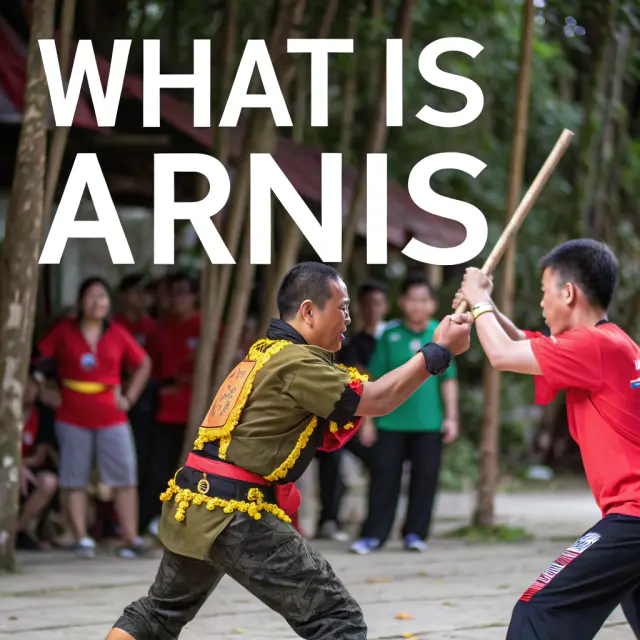
Arnis, also known as eskrima or kali, is the national martial art and sport of the Philippines. Built around rattan sticks, blades, and the idea that almost any object can become a weapon, it is one of the world’s most respected practical fighting systems, and a tradition that survived four centuries of colonial suppression to become a proud symbol of Filipino identity.
This guide explains what arnis is, why it has three names, its remarkable history, and how it became the national sport.
Filipino weapon-based martial art
Eskrima, Kali
Rattan stick (about 70 to 80 cm)
National martial art and sport
Republic Act 9850, 2009
Pre-colonial, around the 14th century
What arnis is
Arnis is the umbrella name for the traditional martial arts of the Philippines, collectively called Filipino Martial Arts, or FMA. Unlike many fighting systems that begin empty-handed, arnis teaches weapons first, emphasising sticks, knives, and bladed weapons, along with improvised tools and open-hand techniques. The logic is practical: learn to handle a weapon, and your empty-hand skills follow naturally.
Why it has three names
Arnis, eskrima, and kali largely refer to the same family of arts, with the name depending on region and tradition. Arnis is most associated with Luzon in the north and comes from the Spanish arnes, meaning armour. Eskrima is common in the central Visayas and derives from the Spanish esgrima, meaning fencing. Kali is often used in the southern Mindanao region and in many schools abroad. Practitioners take their titles from these names, such as arnisador, eskrimador, or kalista.
A history of survival
The art’s roots run deep into the pre-colonial past, to around the 14th century, when indigenous communities developed sophisticated fighting systems using rattan, bamboo, and blades to defend against rivals and invaders.
Its most famous moment came in 1521. Rajah Lapulapu, the ruler of Mactan and, by tradition, a skilled practitioner, led his warriors to defeat Ferdinand Magellan’s expedition, the first recorded repulse of European invaders in the islands.
Under Spanish rule the art was seen as a threat and banned by 1596, but it refused to die. Practitioners hid their training in plain sight, disguising it as folk performances such as the Moro-Moro plays that depicted battles between Christians and Muslims. Through that clever camouflage, the art survived four centuries of suppression, and it resurfaced in the hands of katipuneros wielding bolos during the revolution against Spain, and again during the Philippine-American War.
Weapons and techniques
Arnis is famously versatile, and its training reflects that.
- Single stick: one rattan cane, the most common starting point.
- Double stick (doble baston): two canes of equal length, building coordination and flow.
- Sword and dagger (espada y daga): a long weapon paired with a short one.
- Empty hands (mano mano): strikes, joint locks, grappling, and disarms, often taught as an extension of the weapon movements.
A guiding principle is that anything can be a weapon. The same angles and motions learned with a rattan stick transfer to a bolo, a knife, or even everyday objects, which is a big part of why arnis is prized as a practical self-defence system.
The national sport
Formal recognition came in 2009, when Republic Act 9850 declared arnis the national martial art and sport of the Philippines. The law did more than grant a title: it mandated the teaching of arnis in schools as part of physical education, making sure the tradition would be passed on rather than fade away. This built on earlier steps, including the addition of Filipino martial arts to school curricula in the 1970s and to the national student games.
The choice was deeply symbolic. Where colonial history erased so many indigenous practices, arnis endured, partly because it once hid inside folk dances. Naming it the national sport was an act of cultural pride and preservation. It is worth noting, though, that while arnis holds the official title, basketball remains by far the most widely played game in the country.
Modern recognition
Today, Filipino martial arts enjoy serious global respect. They are considered among the most advanced practical blade systems in the world, are studied by militaries and law enforcement, and form part of modern combatives programs abroad. Masters such as Remy Presas, who created Modern Arnis as a safer way to train, and Dan Inosanto, a close friend and student of Bruce Lee, helped spread the art internationally. Its fluid stick-and-blade movements have even shaped fight choreography in Hollywood action films, introducing arnis to audiences who may not know its name.
Getting started with arnis
Arnis is welcoming to beginners, and many find its weapons-first approach surprisingly easy to pick up. Training usually begins with the twelve basic strikes, the fundamental angles of attack that form the alphabet of the art, practised slowly with a single rattan stick. From there students learn blocks, counters, and simple partner drills like sinawali, the flowing double-stick weaving pattern that builds rhythm and coordination. Because the movements translate directly to empty hands and everyday objects, students gain practical self-defence skills quickly, while the constant partner work keeps classes social and fun.
Arnis in the modern Philippines
Since becoming the national sport, arnis has spread rapidly through Philippine schools, where it is taught in physical education and contested at student games up to the national Palarong Pambansa. Competitive arnis has two main forms: anyo, solo forms judged on technique and expression, and laban, or sparring, in which padded practitioners score points with controlled stick strikes while wearing protective gear. Clubs and federations keep the traditional systems alive alongside the sport, and interest keeps growing among young Filipinos rediscovering an art their ancestors once fought with.
A source of national pride
More than a sport, arnis has become a point of cultural pride. It offers Filipinos a martial tradition entirely their own, one that resisted a colonial ban and helped win the country’s freedom. Learning it connects a modern student to Lapulapu’s warriors and to the revolutionaries who carried bolos against empire. That heritage, as much as the practical skill, is why arnis is treasured today, not only as the national sport but as a living piece of the Filipino story.
A living Filipino legacy
Today arnis is taught not only in the Philippines but in clubs and seminars around the world, carried abroad by Filipino masters and embraced by martial artists of every background. Each new student who picks up a rattan stick helps keep a centuries-old tradition alive. In that sense arnis is both very old and very current, a martial art that honours the past while continuing to grow, one strike, one drill, and one generation at a time. Few national symbols manage to be, at once, a piece of history and a practical skill you can still learn today.
Frequently Asked Questions
What is arnis?
Arnis is the national martial art and sport of the Philippines, a weapon-based system built around rattan sticks and blades, and also known as eskrima or kali.
What is the difference between arnis, eskrima, and kali?
They largely name the same family of Filipino martial arts, differing mainly by region: arnis in Luzon, eskrima in the Visayas, and kali in Mindanao and many overseas schools.
When did arnis become the national sport?
In 2009, through Republic Act 9850, which named arnis the national martial art and sport and required it to be taught in schools.
What weapons are used in arnis?
Mainly rattan sticks, along with bladed weapons like the bolo and knife. Training also includes stick-and-dagger work and empty-hand techniques such as locks and disarms.
Conclusion
Arnis is a fighting art that doubles as a survival story. It armed Lapulapu against Magellan, hid inside folk dances to escape a colonial ban, marched with revolutionaries, and finally took its rightful place as the national sport. Practical, deep, and proudly Filipino, it is a living link to the courage of the country’s past.