Spanish Influences in Filipino Culture: A Legacy
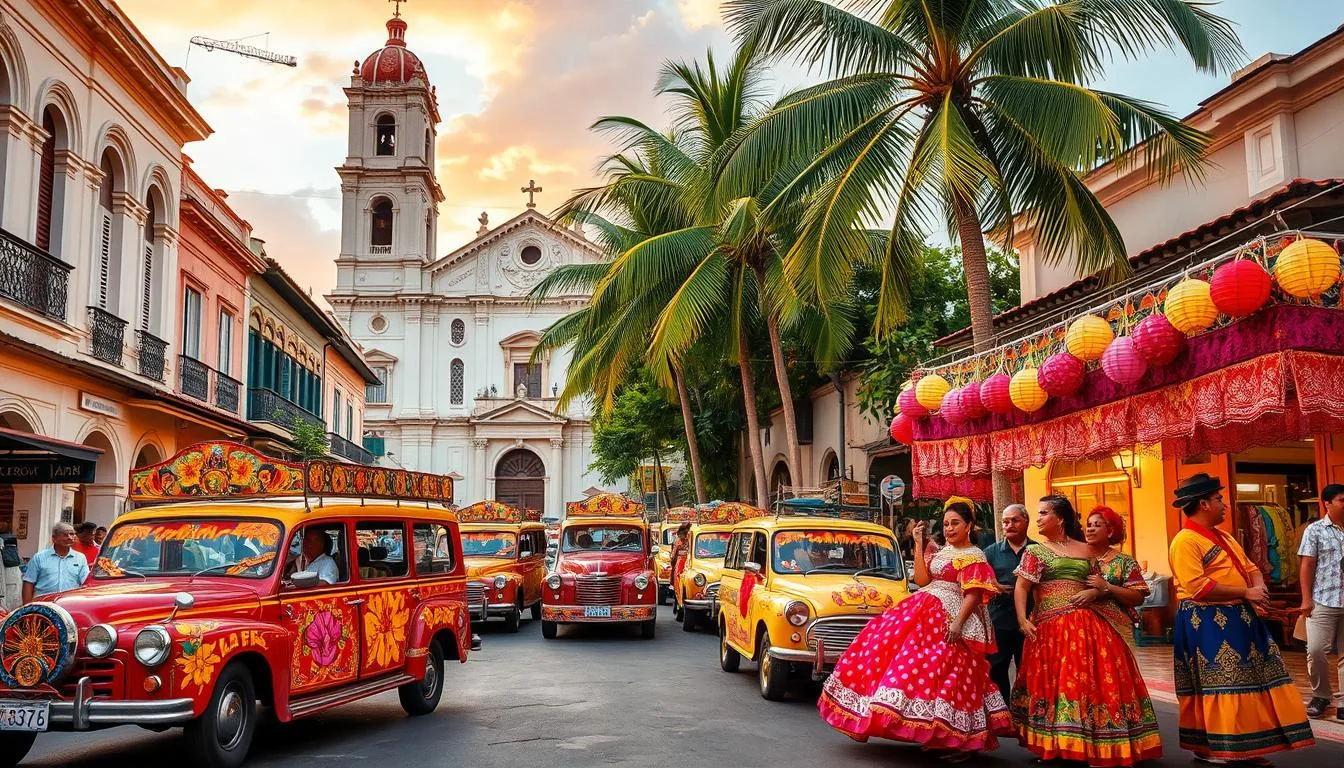
Spanish colonizers ruled the Philippines for 333 years, from 1565 until 1898, the longest colonial occupation the islands ever faced. That long rule left a Spanish colonial tradition that Filipinos still practice every week: Sunday Mass timed to a parish bell, a town fiesta built around a patron saint, and a godparent bound to a child for life.
Spanish friars forced villages to resettle around churches, collected tribute in coin and rice, and demanded free labor on roads and galleons. Alongside that coercion, three centuries of contact produced customs, words and dishes that outlasted the empire itself. This piece traces where those traditions came from and how honestly they sit alongside the history that created them.
At a Glance
| Aspect | Details |
|---|---|
| Colonial period | 1565 to 1898, 333 years |
| Started under | Miguel Lopez de Legazpi, 1565 conquest |
| Core religious legacy | Town fiesta, Santacruzan, Simbang Gabi, Semana Santa |
| Kinship system | Compadrazgo (godparents), from Spanish padrino and madrina |
| Language impact | 21 to 33 percent of Tagalog vocabulary is Spanish-derived |
| Food legacy | Adobo (name only), lechon, paella-derived dishes |
| Visible legacy | Maria Clara and terno dress, baroque stone churches, bahay na bato |
| Cost | Reducción resettlement, tribute, forced labor (polo y servicio) |
How Spanish Rule Reorganized Filipino Communities
Spanish friars did not just introduce customs. They rebuilt where and how Filipinos lived during the Spanish colonization of the Philippines, which began in 1565 under Miguel Lopez de Legazpi.
Colonial officials ordered scattered barangays to relocate into towns built around a church and plaza, a policy known as reducción that followed a grid plan set by royal decree in 1573. Officials called the result bajo de campana, or under the bell, since family life now ran on the schedule of church bells (Koller).
Key point
Men owed polo y servicio, forced unpaid labor on roads, churches and the ships of the Manila galleon trade, though a fee called falla bought an exemption (Koller).
Reducción let friars catechize whole communities at once and let tax collectors track who owed tribute. Every adult paid an annual tribute in coin, gold or rice, a system that later became the cedula personal after 1884. These systems worked together: resettlement made a population easier to tax, convert and conscript.
Filipino resistance to it was constant. Communities fled to the hills, delayed conversion for decades and negotiated the terms of submission town by town. The traditions covered below grew out of that friction, not despite it.
The Fiesta and Patron Saint System
Every Philippine town honors a patron saint, and that custom is a direct spanish colonial tradition. Augustinian, Franciscan and Jesuit friars assigned each new parish a titular saint whose feast day became the town’s biggest yearly event, timed to a church calendar introduced after the 1565 conquest.
Missionaries used the fiesta as a tool of evangelization: gathering scattered families in one place for a shared feast made it easier to preach, baptize and monitor converts than visiting them house by house.
The system did not erase what came before it. Pre-Hispanic community rituals folded into the new format instead of disappearing, which is why fiestas still mix Catholic novenas with harvest offerings, street dancing and food that owes nothing to Spain.
Note
A sponsorship role called hermano mayor, or camarera for a woman, pays for the saint’s procession, the band and the feast, a duty that traces back to precolonial datus who funded community rituals themselves.
Cebu’s Sinulog and Aklan’s Ati-Atihan both grew out of devotion to the Santo Nino, the same child-Jesus image Spanish missionaries are recorded giving to local rulers in the 1500s, which shows how one imported icon multiplied into distinct regional feasts.
Roughly a hundred towns and cities hold a notable fiesta at some point in the calendar year, each one centered on the same patron saint model the friars set up more than four centuries ago. Our separate guide to how a town fiesta actually runs covers the novena, the procession and the open-house custom in full.
Catholic Rites That Became Filipino Custom
Santacruzan and Flores de Mayo
Flores de Mayo began as a European Marian devotion that Spanish missionaries brought to the islands, expanding after the Catholic Church declared the dogma of the Immaculate Conception in 1854. Filipino priest Mariano Sevilla published a devotional booklet in 1867 called Flores de Maria, urging families to dedicate the whole month of May to offering flowers to the Virgin Mary. Children dressed in white still walk to Marian altars each evening that month, carrying candles and blooms.
The Santacruzan closes the month as its grand finale, though it started as a separate Spanish import: a religious pageant reenacting Queen Helena’s search for the True Cross, alongside her son Constantine.
Women called reynas walk the procession dressed as virtues and biblical figures, among them Reyna Fe, Reyna Esperanza and Reyna Caridad, escorted by two boys playing Roman soldiers. Filipino communities merged the solemn search-for-the-cross story with the flower devotion, turning two separate Spanish rites into one hybrid procession now nicknamed the Queen of Filipino Feasts.
Simbang Gabi
Simbang Gabi, also called Misa de Gallo or rooster’s Mass, is a series of nine dawn Masses said in the nine days before Christmas. The custom dates to the Spanish colonial period, when priests scheduled early services so farmers and fishermen could attend before the workday started in the tropical heat.
Many Filipinos still believe completing all nine Simbang Gabi Masses grants a wish, though the church frames it as spiritual preparation rather than a bargain. Churches now hold the Masses in the evening almost as often as at dawn, and street vendors selling puto bumbong and bibingka outside the church doors are as much a part of the ritual as the liturgy itself.
Semana Santa
Semana Santa, or Holy Week, reached the Philippines through the same missionary calendar that brought fiestas and Marian devotions. Towns stage a senakulo, a dramatized retelling of Christ’s passion, and carry life-sized santos, carved wooden images of saints, through the streets on Good Friday.
Note
Some provinces still hold penitential rites where devotees walk barefoot or, in a small number of towns, undergo actual crucifixion reenactments, a practice the Catholic Church itself discourages.
In many homes, the pabasa, a continuous chanted reading of Christ’s passion set to a centuries-old melody, runs for a full day and night inside a makeshift tent beside the house. Holy Week remains the one week a year when Philippine cities empty out, as families travel to home provinces to observe rites their Spanish-era ancestors would recognize.
Compadrazgo: The Godparent System
Spanish Catholicism arrived with its own kinship rules, and compadrazgo is the clearest survivor. The system assigns godparents at baptism, confirmation and marriage, creating a bond the Church treats as spiritual kinship between the godparent and both the godchild and the godchild’s parents. The custom likely reached the Philippines less directly from Spain than through Spain’s colonial network in Mexico, carried across the Pacific by the Manila galleon trade alongside goods and missionaries.
Filipino vocabulary still carries the Spanish origin:
- Ninong and ninang: godfather and godmother, from the Spanish padrino and madrina.
- Kumpare and kumare: the parents’ new tie to each other, from compadre and comadre.
The relationship is not ceremonial only. Ninong and ninang are expected to give an aguinaldo, a Christmas gift, and to step in as guardians if a child’s parents cannot. Choosing sponsors also builds alliances between families, a pattern anthropologists say took firmer root in the Philippines than it ever did in Spain, where the tradition began.
Modern Filipino families extend the same logic past baptism, naming separate ninong and ninang for a debut, a wedding or even a graduation, with each sponsor adding one more thread to a family’s social network.
The Maria Clara Dress and Filipiniana Fashion
Spanish rule changed what Filipino women were expected to wear. Missionaries pushed modesty standards drawn from Catholic teaching, and the loose native baro evolved into a more covered, structured blouse paired with a long skirt called a saya. The ensemble later took the name Maria Clara, after the mestiza heroine of Jose Rizal’s 1887 novel Noli Me Tangere, even though the dress predates the book by decades.
A full set includes four pieces:
- Baro, the blouse
- Saya, the long skirt
- Tapis, a wraparound overskirt
- Panuelo, a shoulder covering
Despite the European silhouette, costume historians classify the Maria Clara gown as a Filipino development rather than a straight import, since it grew out of a native garment reshaped by Spanish-era expectations rather than copied wholesale from Spain (“The Terno”).
By the early 1900s the style evolved again into the terno, dropping the panuelo and fixing the sleeve into the structured butterfly shape still worn at formal occasions today. That dress code became its own spanish colonial tradition, one reason the barong and filipiniana remain the default formalwear at Philippine weddings and state functions.
Spanish Loanwords in Filipino Languages
Language carries the deepest trace of Spanish rule, because Filipinos speak it every day without noticing. Linguists estimate that between one-fifth and one-third of Tagalog vocabulary derives from Spanish, depending on whether a study counts formal dictionary entries or everyday speech. The Spanish Royal Academy uses a conservative 21 percent figure, while an often-cited 1972 study by Llamzon and Thorpe put the share at 33 percent of dictionary word roots. Cebuano absorbed even more Spanish vocabulary than Tagalog did.
Counting numbers, telling time and naming days of the week in most Philippine languages still runs on Spanish, a pattern every Filipino learns in grade school without ever studying the language itself:
| Spanish Word | Everyday Filipino Use | Meaning |
|---|---|---|
| mesa | mesa | table |
| silla | silla | chair |
| kwarto | kwarto | room |
| uno, dos, tres | uno, dos, tres | counting, market prices |
| Lunes through Sabado | Lunes through Sabado | days of the week |
| Enero through Disyembre | Enero through Disyembre | months of the year |
Chavacano, spoken mainly in Zamboanga City by roughly 600,000 people, went further still and became a full Spanish-based creole, the only one of its kind in Asia. Spanish stopped being an official language in 1987, yet it never left the vocabulary Filipinos use to count money, tell time or name a chair.
Food: Adobo, Lechon and Paella-Derived Dishes
Spanish contact reshaped Filipino food, though not always the way people assume. Historian Ambeth Ocampo notes that adobo predates Ferdinand Magellan’s 1521 arrival: Filipinos already marinated meat and fish in vinegar before any Spaniard set foot in the islands (Acabado). What changed was the name. Spanish missionaries saw the vinegar method and labeled it with their own word for a marinade, adobar, and the earliest written record calling it adobo de los naturales appears in a 1612 dictionary.
Lechon, a whole pig roasted over charcoal until the skin cracks, ties more directly to Spanish and wider Iberian roasting traditions and became a centerpiece of Christmas and fiesta tables. Paella arrived as a straightforward import and then localized almost beyond recognition.
Filipino paelya swaps chorizo for local longaniza sausage and tops the rice with sliced boiled eggs, and in Pampanga it turns into bringhe, a coconut milk and turmeric version that keeps little of the original Spanish recipe beyond the layered rice technique itself. Other dishes followed the same path from colonial import to fiesta staple, most reworked with local meat, produce and sugarcane rather than imported Spanish ingredients:
- Puchero
- Morcon
- Embutido
- Leche flan
The dishes people call adobo today owe their name to Spain and their technique to cooks who were already using vinegar centuries earlier.
Colonial Architecture: Churches and Bahay na Bato
Stone Churches
Spanish builders left the most visible spanish colonial tradition standing: the stone church. San Agustin Church in Manila, finished in 1607, is one of four Philippine baroque churches on UNESCO’s World Heritage List, built with earthquake-resistant walls up to 1.5 meters thick after Manila’s earlier timber-and-thatch churches burned repeatedly.
Augustinian, Franciscan and Dominican builders trained local stonemasons and carpenters, who adapted European baroque plans to tropical materials such as coral stone and adobe brick, since imported quarried stone was too costly to ship in bulk. The same earthquake-driven engineering produced Paoay Church in Ilocos Norte, its coral stone buttresses built wide enough to double as walkways during Spanish-era typhoons and tremors.
Town Planning and the Bahay na Bato
Town planning followed the same colonial pattern nationwide: a church facing a central plaza, with government buildings and market streets radiating outward, laid out under Spain’s 1573 ordinances for new towns. Domestic architecture adapted too.
The bahay na bato, or stone house, paired a masonry ground floor with a wooden upper floor and capiz shell windows, a hybrid built for merchant families who wanted Spanish-style permanence without giving up the ventilation a bahay kubo, or nipa hut, already provided in a tropical climate. Both church and house still define how old Philippine town centers look today.
What Actually Survived
None of this reads as a simple export from Spain to the Philippines. Friars imposed reducción, tribute and forced labor, and Filipinos absorbed what served them while quietly reworking or resisting the rest.
A fiesta calendar built for control turned into a genuine expression of local identity. A marinating technique that predates the conquest picked up a Spanish name and stayed Filipino in practice. A godparent system meant to bind Catholic converts became a working social safety net.
What survived did so because communities chose to keep it, adapt it or bury it inside something older. That selective survival, more than any single import, is the real legacy of 333 years of Spanish rule. For a wider look at how these customs play out across the calendar, our Philippine traditions hub covers fiestas, rites and rituals region by region.
Frequently Asked Questions
What is a Spanish colonial tradition?
This term covers any custom, belief or practice that Filipinos adopted, adapted or blended with existing rituals during the 333 years of Spanish rule from 1565 to 1898. The clearest examples are Catholic in origin: the fiesta, Santacruzan, Simbang Gabi and compadrazgo all trace back to policies and devotions the friars introduced. Many of these traditions changed shape once Filipino communities took them over, so calling something Spanish colonial does not mean it stayed identical to its origin in Spain.
What are examples of Spanish colonial traditions still practiced today?
The town fiesta honoring a patron saint, the Santacruzan procession, the nine dawn Masses of Simbang Gabi, and the compadrazgo godparent system are the clearest surviving examples. Food shows the same pattern: paella, lechon and vinegar-based dishes sold under the Spanish name adobo remain fixtures at Filipino celebrations. The Maria Clara dress and colonial-era churches such as San Agustin in Manila count as visible, physical examples of the same legacy.
How did Spanish rule shape Philippine music and dance?
Spanish missionaries introduced European instruments, choral singing and ballroom forms such as the jota and the fandango, which Filipino musicians reworked into regional folk dances still performed at fiestas. Rondalla ensembles, string bands built around the Spanish-derived bandurria and guitar, grew out of this exchange and remain common at town celebrations. Parish choirs also trained generations of local singers and organists, shaping Filipino choral tradition well beyond church walls.
Did Spanish colonization influence Philippine literature and visual arts?
Yes. The first book printed in the Philippines, Doctrina Christiana in 1593, was a Spanish and Tagalog catechism that introduced print literacy to the islands. Colonial-era painting and sculpture centered on religious subjects, produced by Filipino artisans trained in Spanish techniques inside church workshops, according to the National Commission for Culture and the Arts. Later Filipino writers, including Jose Rizal, wrote in Spanish while criticizing the colonial system itself, turning the colonizer’s language against colonial rule.
Why do so many Filipino surnames sound Spanish?
Governor-General Narciso Claveria ordered the Catalogo Alfabetico de Apellidos in 1849, a catalog that assigned surnames to Filipino families who lacked a fixed one, partly to fix confused tax and church records (“Find Your Family Name”).
The catalog listed both Spanish and indigenous names, so not every assigned surname was Hispanic, but common ones such as Santos, Reyes, Cruz and Garcia trace back to it. Having a Spanish surname today does not necessarily mean Spanish ancestry, since very few Spaniards actually settled in the islands during the colonial period.
Works Cited
Acabado, Stephen B. “Philippine Kitchens Already Global When Magellan Arrived.” Rappler, n.d., www.rappler.com/voices/thought-leaders/time-trowel-philippines-kitchens-global-when-magellan-arrived/.
“Find Your Family Name in This Catalog of Historical Surnames From the Spanish Colonial Era.” Esquire Philippines, 2 Nov. 2019, www.esquiremag.ph/culture/books-and-art/surname-spanish-catalog-a00304-20191102.
Koller, Jared. “Under the Church Bell: Reducción and Control in Spanish Philippines.” The Digital Archaeological Record, n.d., core.tdar.org/document/444892/under-the-church-bell-reduccion-and-control-in-spanish-philippines.
National Commission for Culture and the Arts. “The Spanish Colonial Tradition in Philippine Visual Arts.” National Commission for Culture and the Arts, n.d., ncca.gov.ph/about-ncca-3/subcommissions/subcommission-on-the-arts-sca/visual-arts/the-spanish-colonial-tradition-in-philippine-visual-arts/.
“Spanish Vocabulary in Tagalog (Filipino).” LangFocus, n.d., langfocus.com/spanish-language/spanish-vocabulary-tagalog-philippines/.
“The Terno: Living Silhouette of the Filipino Soul.” Positively Filipino, n.d., www.positivelyfilipino.com/magazine/the-terno-living-silhouette-of-the-filipino-soul.
“Understanding the Difference: Flores de Mayo and Santacruzan.” Tribune, Daily Tribune, 10 May 2025, tribune.net.ph/2025/05/10/understanding-the-difference-flores-de-mayo-and-santacruzan.