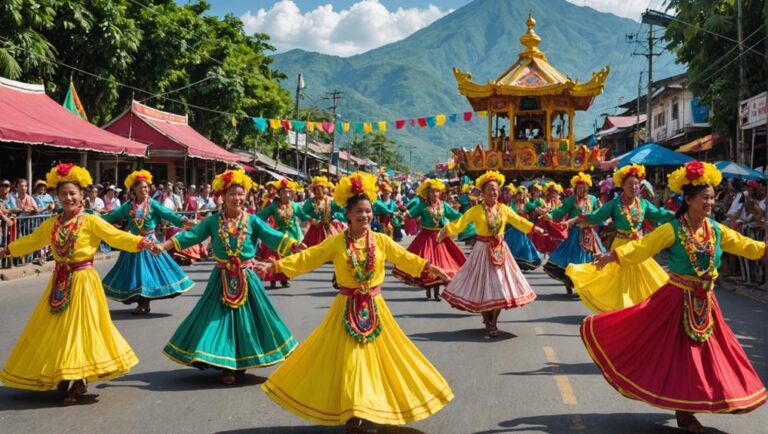
What is Ati-Atihan Festival
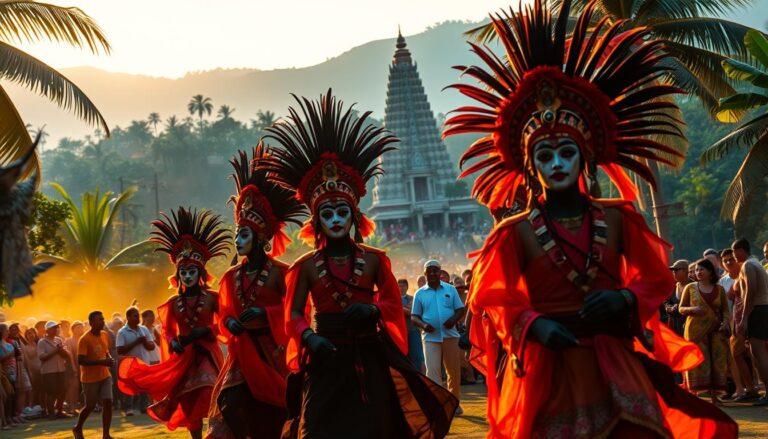
Every third Sunday of January, the streets of Kalibo, Aklan fill with dancers whose skin is smeared black with soot and whose bodies carry an Ati-Atihan festival costume built from feathers, shells, bark cloth and, on many contingents now, recycled plastic. Kalibo sits on Panay Island in Western Visayas, and the festival centers on devotion to the Santo Niño, the infant Jesus image that Spanish missionaries brought to the islands.
Ati-Atihan means “to imitate the Ati,” the Negrito people who lived on Panay long before Malay settlers arrived by boat. That name explains most of what happens during the week: the soot, the drumbeats, the tribal dress.
What started as a small thanksgiving ritual now runs for more than a week, with religious processions, a costume competition worth millions of pesos in prize money, and a barrier-free street party called the sadsad, where any visitor with painted skin and a sense of rhythm can join the dancing.
At a Glance
| Aspect | Details |
|---|---|
| Location | Kalibo, Aklan, on Panay Island in Western Visayas |
| When | Closes the third Sunday of January (Jan. 18, 2026); events run roughly Jan. 12 through 21 |
| Celebrates | Devotion to the Santo Niño, layered onto an older Ati thanksgiving dance |
| Key events | Novena and high mass, the sadsad street-dancing contest, the Santo Niño procession, the awarding ceremony |
| Who attends | Dozens of registered tribes, plus thousands of residents and tourists who join the informal sadsad |
| Getting there | Fly or travel by land into Kalibo; ride-hailing apps do not operate in Aklan, so visitors rely on tricycles or walking during the festival |
Key point
Local and national media call Ati-Atihan the Mother of Philippine Festivals, a title the National Commission for Culture and the Arts gave it for inspiring both the Sinulog and the Dinagyang festivals.
What Is the Ati-Atihan Festival?
The Ati-Atihan Festival is Kalibo’s annual feast for the Santo Niño, held every January and built around street dancing, drumming and elaborate costuming rather than choreographed stage shows. The Aklan provincial and Kalibo municipal governments organize the event jointly, with the Catholic Diocese of Kalibo running the religious side, including the novena, high mass and the transfer of the Santo Niño image through the city.
Dozens of costumed groups, known locally as tribes, register for the street-dancing contest, and thousands more residents and tourists paint their faces and join the informal parade without competing for prizes.
The Legend Behind the Festival: Ati and Bornean Datus
The most repeated origin story comes from the Maragtas, a collection of Panay oral history that writer Pedro Monteclaro compiled in the early 20th century. In the account, ten datus, or chieftains, fled Borneo around 1212 to escape the rule of Sultan Makatunaw. Led by Datu Puti, they landed on Panay, where the Ati people already lived under a leader named Marikudo.
Datu Puti asked to buy land for permanent settlement. Marikudo’s wife, Maniwantiwan, held out until Datu Puti’s wife, Pinangpangan, gave up her own gold necklace. The final price for the lowlands was a golden salakot, a wide brimmed hat, and that necklace.
Once the deal was struck, the Bornean settlers moved into the coastal plains and the Ati withdrew to the mountains. To mark the friendship, the newcomers blackened their skin with soot to look like their former hosts, danced and sang in gratitude.
Note
Historians treat the Maragtas as folk history rather than a verified record: no contemporary document from the 13th century confirms it.
The Aklan provincial government still repeats the story as the accepted local account of how Panay was settled, and Marikudo and Maniwantiwan remain fixtures of Kalibo’s festival lore even where scholars are skeptical. For a longer walk through the different versions of the legend, our Ati-Atihan Festival guide covers each account side by side.
From Pagan Ritual to Santo Niño Devotion
The soot-painted thanksgiving dance predates Christianity in the Philippines. Spanish missionaries arrived on Panay in the late 1500s and layered Catholic devotion onto the existing celebration rather than replacing it outright, a pattern the colonial government used across the islands to draw scattered communities into parishes.
Devotion to the Santo Niño in Kalibo has its own separate legend. A Catholic priest, Msgr. Jose Iturralde, recorded that in the early 1700s a fisherman from Barangay Naile pulled a carved wooden figure from his net instead of fish. He tried to discard it twice, and twice it reappeared in his net, so he kept it. That figure became the object of local devotion that eventually merged with the Ati thanksgiving dance already practiced in the area.
By the time Spanish record keeping caught up with local custom, the two threads, the indigenous soot dance and the Catholic feast of the Santo Niño, had become one event. Today’s festival keeps both: a solemn novena and high mass for the Santo Niño, and a street celebration that still opens with painted faces and drums.
The Ati-Atihan Festival Costume
So what is the costume of the Ati-Atihan festival, exactly? There is no single answer, because the Ati-Atihan festival costume changes depending on which competition category a tribe enters and how much time and money its members put into building it. What stays constant across every version is the base layer: dark paint on the skin and improvised materials built up from there.
Soot and Body Paint
Dancers still darken their skin with soot, a fine black carbon powder, to recall the appearance of the Ati people the festival is named for. Some tribes now use commercial black face paint instead of raw soot because it washes off more easily, but the visual effect is the same. Vendors around Pastrana Park sell small tins of black paint to tourists for a few pesos so visitors can join the informal street dancing without wearing a full costume.
Tribal Headdresses
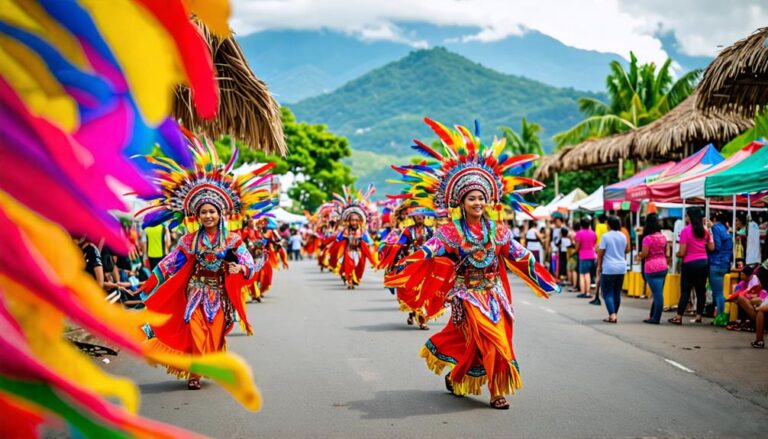
The headdress carries the most weight in judging, and tribes spend months building it. A competitive headdress can rise a foot or more above the dancer’s head, built on a woven bamboo or rattan frame and covered in rooster feathers, dyed chicken feathers, or ostrich plumes for the higher budget contingents.
Smaller shells, seed beads and carved wooden pieces get wired on to fill gaps and catch light. Judges score headdresses separately from the rest of the outfit, which is why some tribes put more of their budget into the headpiece than the body covering.
Fabric Layers and Shell Ornamentation
Underneath the headdress, traditional costumes build up in layers rather than a single garment. Older, more indigenous-leaning entries use coconut husks, dried banana leaves, woven abaca mats, bamboo strips and tiger grass, the same plant fiber Aklan weavers use for textiles. Capiz and other small shells get sewn or wired onto the fabric in patterns across the chest, arms and headdress, adding both texture and a rattle of sound as the wearer dances.
Wooden beads, carved bone pieces and rooster feather trim finish the look. The costume and props of the Ati-Atihan festival often extend past clothing entirely: dancers carry hand carved shields, wooden spears, drums and gongs as part of the overall presentation, and judges score how well the props match the costume theme.
Newer contingents in the Modern category skip natural materials almost entirely. Recycled PET bottles, cut Yakult containers, old CDs, bottle caps and even plastic cutlery get reshaped into sequins, fringe and armor plating. It looks nothing like the original soot-and-leaves version, but it grew directly out of the same competition and still answers to the same rules on headdress, costume and street dancing.
Tribe Categories in the Competition
Kalibo’s tribal street-dancing contest runs across four categories:
- Tribal Big
- Tribal Small
- Modern Tribal: allows fabric, sequins and synthetic ornamentation, giving costume designers far more room to experiment
- Traditional, or Balik-Ati (“return to the Ati”): the strictest category, requiring costume built entirely from natural, indigenous materials, closest to what the earliest celebrants would have worn
Prize money has grown along with the competition. Recent Ati-Atihan festivals allocated over ₱3.6 million in tribal competition prizes across all four categories, with more than 60 tribes registered in a single year. Special awards for best headdress, best costume and best street dancing carry their own cash prizes on top of the category placings.
Organizers also cap each tribe at 50 drummers, a rule meant to keep the contest focused on the quality of the costume and choreography rather than sheer noise.
What Participants Wear Versus What Tourists Can Wear
Competing tribe members spend weeks, sometimes months, sewing shells onto fabric and wiring feathers into headdress frames, and they wear the full costume of the Ati-Atihan festival only for the judged parade route.
A male Ati-Atihan festival costume for a competing dancer typically means a bare or lightly wrapped torso, cloth or grass skirt layers, ankle and wrist ornaments, and the full headdress. A female Ati-Atihan festival costume adds a wrapped halter or bandeau top, a longer skirt built from the same shell and feather materials, and usually a lighter headdress so the dancer can move freely through hours of street dancing.
Kalibo also holds the Binibini ng Kalibo Ati-Atihan pageant, where contestants wear an elaborate Ati-Atihan festival queen costume that blends the tribal materials, feathers, shells, and beadwork, with pageant-style tailoring rarely seen on the competing street tribes.
Tip
A rented costume will not match a competition tribe’s months of work, but it is enough to join the sadsad without standing out as a spectator.
Tourists do not need to join a registered tribe to take part. Stalls near the plaza rent a basic costume for the Ati-Atihan festival, usually a printed vest or wrap, a simple feather accent and face paint, for the afternoon. The same soot-and-costume tradition survives further east in Leyte, where dancers at the Pintados Festival paint their bodies to honor the island’s tattooed warriors instead of the Ati.
January Schedule: When to Watch the Ati-Atihan Festival
The Ati-Atihan Festival always closes on the third Sunday of January, which falls on January 18 in 2026. The Kalibo municipal government schedules the broader run of events from roughly January 12 through 21, giving visitors more than a week of smaller activities, food fairs and a product expo before the main weekend.
The Saturday before the closing Sunday is reserved for the sadsad, the judged street-dancing contest where tribes parade their finished costumes past the judging area near Pastrana Park. Sunday brings the grand procession, a high mass for the Santo Niño and the final scoring for every competition category.
Security tightens noticeably during the closing weekend. Expect road closures around the Poblacion, limited ride-hailing service since apps like Grab do not operate in Aklan, and reliance on tricycles or walking to get around the festival zone.
Three Days of Tribal Parading
The festival’s public face runs across three main days:
- Day one: Smaller barangay-level parades and try-outs, introducing costumes and choreography to local audiences before the main contest.
- Day two: The sadsad proper, when registered tribes parade the full length of the route in front of judges scoring headdress, costume and street dancing as separate categories.
- Day three: The closing Sunday, opening with a solemn procession carrying the Santo Niño image through Kalibo’s streets, followed by a high mass, a final combined parade and the awarding ceremony.
Throughout all three days, the informal sadsad never really stops. Anyone in face paint can fall into a passing tribe’s drumbeat and dance along, the detail most first-time visitors remember longer than the competition results.
How Ati-Atihan Differs from Sinulog and Dinagyang
Ati-Atihan, the Sinulog Festival in Cebu and the Dinagyang Festival in Iloilo all honor the Santo Niño, and all three trace some part of their identity back to Kalibo’s original celebration. Ati-Atihan and Sinulog actually land on the same day, the third Sunday of January, while Dinagyang follows a week later on the fourth Sunday.
The differences show up fastest in sound and structure. Kalibo’s crowd shouts “Hala Bira!” as tribes pass, and the dancing stays loose and improvised, with tourists and locals moving alongside registered tribes at the same time. Set next to the Sinulog Festival and the Dinagyang Festival, the contrast looks like this:
| Festival | Location | Date | Dance style | Feel |
|---|---|---|---|---|
| Ati-Atihan | Kalibo, Aklan | Third Sunday of January | Loose, improvised, danced to “Hala Bira!” | Open street party; tourists dance alongside tribes |
| Sinulog | Cebu City | Third Sunday of January (same day) | Two-steps-forward, one-step-back, danced to “Pit Señor!”; paired with a fluvial procession | More structured, devotional |
| Dinagyang | Iloilo City | Fourth Sunday of January (a week later) | Tightly choreographed tribu routines in a single Ati Competition | Theatrical, closer to a staged show |
Ati-Atihan keeps the rawest version of the shared tradition. Its costumes lean harder on natural materials and soot, its dancing stays open to anyone willing to paint their face, and its four competition categories still reward the groups that hold closest to the original Bornean-and-Ati story.
Where Ati-Atihan Fits Today
A soot-covered dancer in a shell-trimmed headdress is still the clearest shorthand for Kalibo in January, even as PET-bottle armor and sequined fabric push the costume in new directions each year. The four contest categories, the millions of pesos in prizes and the open sadsad all exist to keep that image alive for one more generation of tribes.
Kalibo’s festival is one stop on a much longer calendar of tribal, religious and harvest celebrations held across the country every year, and our Philippine festivals category tracks where and when each one happens.
Frequently Asked Questions
Do You Need a Ticket to Watch the Ati-Atihan Festival?
No. The street parades, the sadsad and the religious processions are free and open to the public. Paid seating exists only for grandstand views near the main judging area during the Sunday finals, and reservations for those seats typically go through the Kalibo tourism office ahead of the festival.
How Much Does It Cost to Rent an Ati-Atihan Costume in Kalibo?
Basic rental costumes, a printed vest, wrap skirt and face paint, cost a few hundred pesos for the day from stalls near Pastrana Park during festival week. Prices rise closer to the peak weekend, so visitors who want a costume without haggling should rent early in the week rather than on the final Saturday or Sunday.
Is the Black Body Paint in Ati-Atihan Considered Offensive?
It is debated. Some cultural commentators have raised concerns that non-Ati participants darkening their skin resembles blackface, while festival organizers and most Aklan residents describe the paint as a tribute to the Ati people rather than mockery. No academic consensus settles the question, and the practice continues largely unchanged.
What Is the 2026 Ati-Atihan Festival Theme?
Kalibo’s 2026 festival runs under the theme “Hala Bira Bagong Kalibo,” tying the traditional festival shout to a message about the city’s ongoing development.
Can Foreign Tourists Join the Street Dancing?
Yes. The sadsad has no barrier between performers and spectators, and tourists routinely paint their faces, buy a simple costume from a nearby stall and dance alongside registered tribes. Joining the official competing tribes requires registering weeks in advance through a tribe’s organizer, but the open street party welcomes anyone.
Works Cited
“Historical Background.” Aklan Provincial Government, aklan.gov.ph/profile/historical-background/.
“Ati-Atihan Festival.” Britannica, Encyclopaedia Britannica, www.britannica.com/topic/Ati-Atihan-Festival.
“Over P3.6-M in Prizes up for Grabs in Kalibo’s Ati-Atihan Festival.” Philippine News Agency, pna.gov.ph/index.php/articles/1266968.
“31 Tribes Prepare for Kalibo’s ‘Sadsad Ati-Atihan’ Contest.” Philippine Information Agency, pia.gov.ph/news/31-tribes-prepare-for-kalibos-sadsad-ati-atihan-contest/.
“Ati-Atihan, Dinagyang, Sinulog: A Look at 3 Festivals Honoring Sto. Niño.” Philstar.com, 28 Jan. 2024, www.philstar.com/lifestyle/travel-and-tourism/2024/01/28/2328771/ati-atihan-dinagyang-sinulog-look-3-festivals-honoring-sto-nio.