Giant Lantern Festival San Fernando: Ligligan Parul Dates, Meaning, and Visit Tips
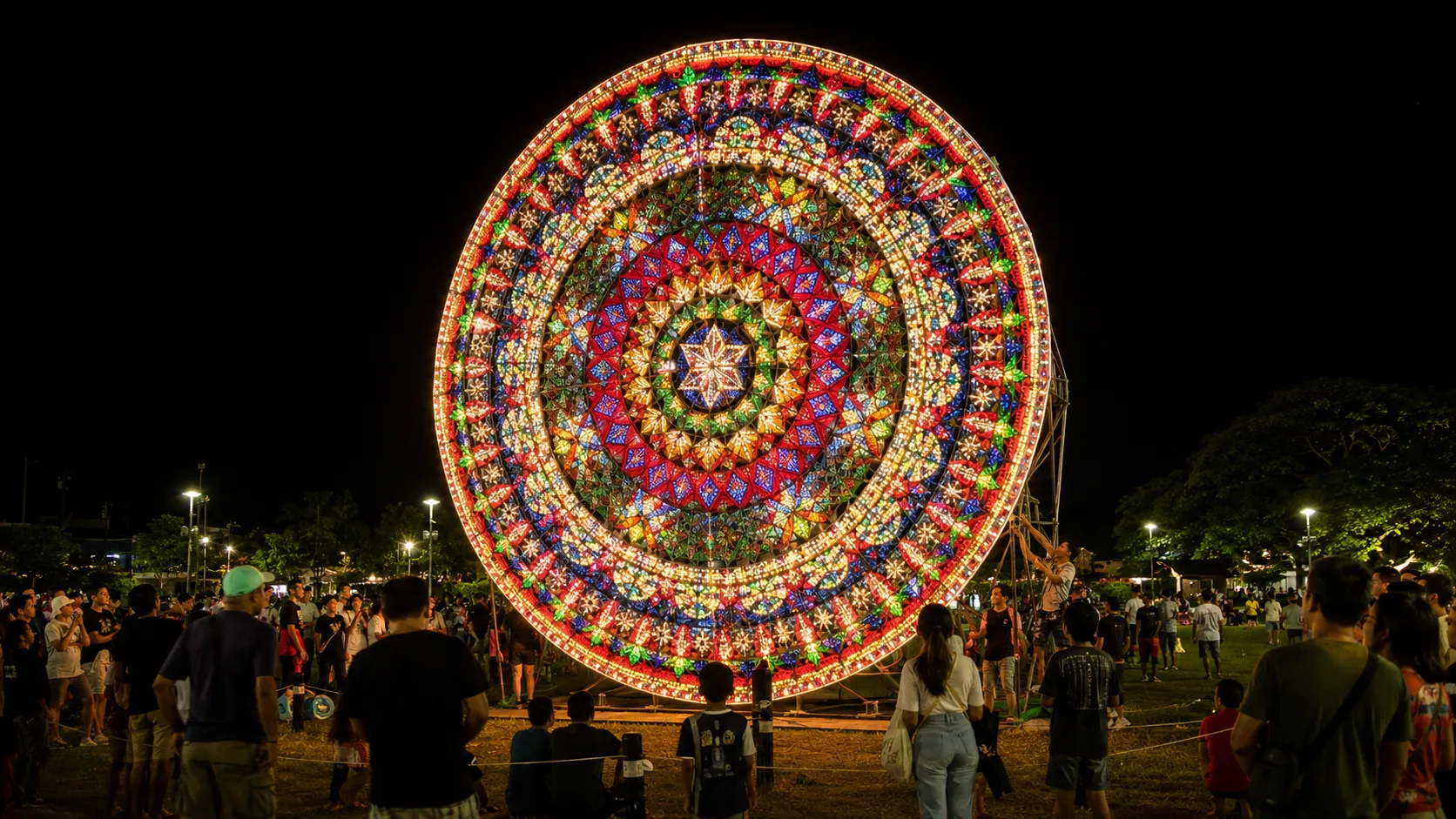
The Giant Lantern Festival, or Ligligan Parul, is a December night of competing giant Christmas lanterns in the City of San Fernando, Pampanga. Barangay teams light huge parol in timed patterns set to music. The craft is the event.
As of 12 September 2026, the city has not published a 2026 competition date that this page will treat as a ticket. Ask the City of San Fernando tourism office, or the festival’s own announcement, before you book a hotel for a guessed Saturday.
This guide covers the Kapampangan name, the city’s Christmas capital reputation as it is commonly reported, how the lantern contest works at a high level, the December timing pattern from recent editions, and visitor etiquette.
Use this page as the only Giant Lantern Festival URL. Pair it with the Pampanga hub and the December hub when you plan a wider trip.
Key facts
| Item | What to use |
|---|---|
| Place | City of San Fernando, Pampanga |
| Local name | Ligligan Parul, Kapampangan for lantern competition |
| Usual window | December, often a Saturday night before Christmas |
| 2026 date | Not confirmed here. Do not book a specific night from an old listing. |
| What it is | A barangay competition of giant parol, the Kapampangan Christmas lantern |
| What it is not | The same event as the Sinukwan Festival, which is a separate cultural festival in the same city |
| Recent contest nights | 17 December 2022, 16 December 2023, 14 December 2024, and 13 December 2025, all Saturdays |
| Recent main venue | Robinsons Starmills in several documented editions; confirm the 2026 ground |
| After the contest | Recent years have shown the lanterns on later exhibition nights into early January |
| Booking note | Confirm the night, gate time, and venue with the city before you lock non-refundable travel |
At a glance
| Item | What to know |
|---|---|
| Event | Ligligan Parul (Giant Lantern Festival) |
| Where | City of San Fernando, Pampanga |
| Usual timing | One December night, often a Saturday before Christmas (confirm each year) |
| What you see | Barangay teams with giant lighted parol scored with music |
| Not the same as | Sinukwan Festival (separate cultural programme in the same city) |
| Confirm with | City of San Fernando / official festival channels before you book the night |
What Ligligan Parul means
Ligligan Parul is the Kapampangan name of the festival. Ligligan means a contest. Parul means lantern. English coverage usually says Giant Lantern Festival. Local speech still uses Ligligan Parul for the competition night itself.
The lantern of San Fernando is also called Parul Sampernandu. The Filipino word parol comes from the Spanish farol, meaning lantern. In Philippine Christmas practice, the star lantern stands for the Star of Bethlehem and for light in a dark season.
The contest grew from an older religious habit called lubenas. That is a nine-day novena walk with lanterns before Christmas, close in season to Simbang Gabi. Accounts place the San Fernando lantern contest in the early 1900s. Some sources say 1904. Others say 1908.
Recent city editions have been numbered as if the count starts around 1908: the 114th in 2022, the 115th in 2023, the 116th in 2024, and the 117th in 2025.
Festival histories also say electricity arrived in San Fernando in 1931 and that wired, switching lights then changed the lanterns from simple paper stars into the giant, dancing displays people come to see.
Treat those origin years as reported history, not as a reason to invent a 2026 Saturday.
In one line: Ligligan Parul is San Fernando’s December lantern contest, a night when barangay teams light giant parol in patterns, not a week-long street parade and not the Sinukwan Festival.
Christmas capital reputation
The City of San Fernando presents itself as the Christmas Capital of the Philippines. That line appears on the city’s own website and in mayor and tourism remarks during festival years. News reports repeat it often because of the lantern industry and this December contest.
It is a widely used city reputation. It is not a claim that every Filipino Christmas custom began here, and it is not a substitute for a published 2026 programme. Other towns also light parol and hold December events.
San Fernando is famous for making the lanterns very large and for turning that craft into a judged night.
For the wider month, use the December festivals hub when that page is live. For other Kapampangan events, use the Pampanga festivals hub. Home décor, Noche Buena, and season customs belong on Philippine Christmas traditions. Dawn Masses belong on Simbang Gabi.
How the lantern competition works
Each competing barangay builds one giant lantern. Recent documented years have fielded about ten village entries. A team of lantern makers, electricians, and rotor operators spends months on the frame, colors, wiring, and light sequence.
On contest night the lanterns are staged in an open ground. Each entry is given time to run its lighting show to music. The lights switch in patterns so the lantern looks as if it is dancing.
Festival histories describe steel frames, colored plastic, thousands of bulbs, and large rotors that time the on and off sequence. Exact size, wattage, and bulb rules change by year. Do not treat an old number as this year’s specification.
Judges score the night. Recent editions have named a champion barangay and runners-up. Prize amounts have been published for those years. They are not a 2026 promise. After the ligligan, the city has often kept the lanterns on public exhibition.
In 2025 the tourism office listed display nights from 14 December 2025 to 1 January 2026 at Robinsons Starmills, with extra stops at Capital Town, the city hall and cathedral area, City Town Center in Calulut, and Marquee Mall in Angeles. That was last year’s map.
Ask for this year’s exhibition list if you cannot attend the contest night.
- The main event is one night, not a week-long parade.
- Barangay teams compete with one giant lantern each.
- The show is the lighting sequence set to music.
- A later exhibition run is common, but dates and sites are announced each year.
- Venue, gate time, and ticket or viewing rules belong to the current city notice.
December timing pattern
Provincial listings have long described Ligligan Parul as a December Saturday, sometimes as the Saturday before Christmas Eve. Recent contest nights match the Saturday-in-December habit more than a single fixed calendar rule.
Documented competition dates include Saturday 17 December 2022, Saturday 16 December 2023, Saturday 14 December 2024, and Saturday 13 December 2025. Those nights were mid-December, not always the last Saturday before the 24th. A pattern is useful for planning a flexible trip.
It is not a published 2026 programme.
As of 12 September 2026, this page will not name a 2026 Saturday. Confirm the night with the City of San Fernando. If you hope to see both lantern night and Sinukwan, confirm those calendars as two separate questions. Sinukwan weeks have moved between mid-November and early December. Details: Sinukwan Festival guide.
Planning table: when to be in San Fernando
| Traveler goal | Better timing | Notes |
|---|---|---|
| See the ligligan (contest night) | The Saturday the city announces | Arrive early for a full view of a lantern, not the back of a crowd |
| See lanterns with a lighter crowd | Exhibition nights after the contest | Recent years ran displays into early January; confirm sites and hours |
| Combine with Kapampangan street dance | Sinukwan week, if it is on | Separate event. Confirm both calendars. Do not assume they overlap. |
| Combine with dawn Masses | Customary Simbang Gabi window of 16 to 24 December | Parish times vary. This is worship, not the lantern contest. |
| First visit, flexible dates | Wait for the city announcement, then add buffer days | Book refundable lodging if you can |
How to plan the trip
- Lock the December window, then wait for the city’s night and venue before you choose an exact hotel block.
- Decide whether you need the contest night or can accept a later exhibition.
- Do not assume last year’s mall ground. Recent editions used Robinsons Starmills. That can change.
- Travel from Metro Manila is usually by the North Luzon Expressway into San Fernando. Road time depends on traffic, especially on a contest Saturday.
- Bring water, a light layer for a cool evening after a hot day, and a plan for children in a packed ground.
- Recheck city and festival channels in the final week before you travel.
Place this night inside the national calendar with the complete festivals guide. For festival types, see the festivals overview. If you need the civic versus religious distinction in plain language, see what are fiestas.
Visitor etiquette and photo tips
- Treat contest night as a seated or standing show. Give marshals and barangay crews a clear lane.
- Arrive early if you want the face of a lantern in your frame. Late arrivals often see heads and phone screens.
- Do not use flash on the lanterns or in someone’s face. Flash washes out the light dance and bothers the crowd.
- Stay behind barriers. Do not climb frames, touch wiring, or walk under a lantern for a closer shot.
- Ask before close portraits of makers, rotor operators, or children in the holding area.
- Phone night mode is usually enough. A small tripod helps only if the venue allows it and you are not blocking an aisle.
- Exhibition nights can be easier for photos than the packed contest Saturday.
- If a display is set between city hall and the cathedral, treat church grounds as a worship space, not a studio.
- Keep children where you can see them. Agree on a meeting point away from the main view line.
- Follow bag checks and local safety rules. The city has used an incident command setup on contest night in recent years.
Keep Sinukwan and lantern night separate
Both events are associated with the City of San Fernando. They are not one festival. Sinukwan is a Kapampangan cultural week of street dance, pageants, food, and craft. Ligligan Parul is a Christmas-season lantern contest.
A provincial calendar may list both in the late-year cluster. That does not mean they share a date. Confirm each host notice if you want both on one trip.
Confirm it here
- City of San Fernando: cityofsanfernando.gov.ph
- Festival background page: giantlanternfestival.com/about
- Sinukwan, a different festival in the same city: Sinukwan Festival
- Pampanga hub: Festivals in Pampanga
- December hub (use when live): December festivals in the Philippines
Quick summary
When is the Giant Lantern Festival? It is a December night in the City of San Fernando, Pampanga, often a Saturday before Christmas. Recent contest nights were 17 December 2022, 16 December 2023, 14 December 2024, and 13 December 2025. The 2026 date is not confirmed on this page. Confirm with the city before you travel.
What is Ligligan Parul? It is the Kapampangan name for the lantern competition. Barangay teams light giant parol in patterns set to music.
Is San Fernando the Christmas Capital of the Philippines? The city uses that title and news reports repeat it because of the lantern industry and this festival. Treat it as a commonly reported city reputation, not as a reason to skip a date check.
Is this the same as Sinukwan? No. Sinukwan is a separate cultural festival in the same city.
How to get there from Metro Manila (NLEx pattern)
The City of San Fernando, Pampanga, sits on the usual North Luzon Expressway (NLEx) corridor north of Metro Manila. Travel time depends on traffic, toll queues, and contest-night congestion. Do not treat a blog’s clock time as a guarantee.
- By private vehicle: Take NLEx northbound and follow exits signed for San Fernando. Ask your map app for the year’s venue pin only after the city names the ground. Contest Saturday evenings can jam roads near malls.
- By provincial bus: Pampanga-bound buses from major Metro Manila terminals commonly pass San Fernando. Tell the conductor your drop target (for recent editions, riders often ask for Robinsons Starmills or nearby mall landmarks). Confirm the current drop-off with the bus company on your travel day.
- From Clark: If you fly into Clark, arrange a separate land transfer into San Fernando. Clark and San Fernando are related Central Luzon points, not the same festival gate.
Recheck the City of San Fernando tourism notice for gate time, parking rules, and any shuttle pattern for the night you attend.
Lodging: near Robinsons Starmills vs downtown San Fernando
Several recent contest nights used Robinsons Starmills as the main ground. That can change. Choose lodging for the venue the city actually posts.
| Base | Better if you want | Trade-off |
|---|---|---|
| Near Robinsons Starmills / Jose Abad Santos Avenue mall cluster | Shortest walk or ride to recent contest and exhibition grounds | Busy on contest night; book early when the date is published |
| Downtown San Fernando (city hall / cathedral side) | Easier mix of city hall, cathedral, and some exhibition stops when those sites are used | May need a ride to a mall ground if the ligligan is not downtown |
| Angeles / Clark hotels | More hotel inventory for some travelers | Longer post-show return after a packed Saturday night |
Prefer refundable lodging until the city publishes the 2026 night and venue. Exhibition nights after the contest can be easier for families than the packed ligligan Saturday, when those displays are announced.
2026 competition night: still confirm when unpublished
As of the 12 September 2026 review on the live guide, Festive Pinoy does not treat any 2026 Saturday as a confirmed ticket. Recent contests fell on mid-December Saturdays (2022 to 2025), which is a planning pattern only.
- Do not book a non-refundable room for a guessed December Saturday.
- When the City of San Fernando publishes the 2026 ligligan date, gate time, and ground, update this section with that named notice.
- Keep Sinukwan on a separate calendar check. It is not the lantern contest.
- Confirm exhibition nights separately if you will miss contest night.
Confirm-host rule: Use the City of San Fernando (cityofsanfernando.gov.ph) and the festival’s own announcement for the night you will attend. A Saturday-before-Christmas habit is not a published 2026 programme.
FAQ
When is the Giant Lantern Festival?
It is a December night in the City of San Fernando, Pampanga. Recent editions fell on a mid-December Saturday. The exact 2026 date is not confirmed on this page. Check the city before you travel.
What is Ligligan Parul?
Ligligan Parul means lantern competition in Kapampangan. It is the local name of the Giant Lantern Festival. Barangay teams light giant Christmas lanterns in patterns. The craft is the event.
What is the Giant Lantern Festival?
It is San Fernando’s Christmas-season contest of giant parol. Each competing barangay presents one lantern. The show is the lighting sequence, not a long parade through the city.
Is this the same as the Sinukwan Festival?
No. Both are associated with the City of San Fernando. Sinukwan is a cultural festival whose dates have fallen in November or early December. The lantern festival is a Christmas-season night competition.
Where is it held?
In the City of San Fernando, Pampanga. Several recent contest nights were at Robinsons Starmills. The ground and the gate time are announced with the year’s date. Confirm both.
Can I still see the lanterns if I miss contest night?
Often yes. Recent years have put the lanterns on exhibition after the ligligan, sometimes into early January, at malls and city sites. Ask tourism for the current exhibition list. Do not copy last year’s hours.
Can I book a Saturday in December 2026 now?
Not from this page. A Saturday-before-Christmas pattern is not a published programme. Confirm the night with the city. Use a flexible booking if you must reserve a room early.
Why is San Fernando called the Christmas Capital of the Philippines?
The city uses that title, and reports repeat it because of the Parul Sampernandu industry and Ligligan Parul. It is a commonly reported reputation. It does not replace a current date notice.
Last reviewed against city, festival, and news sources as of 12 September 2026. Always confirm with the host city.
—